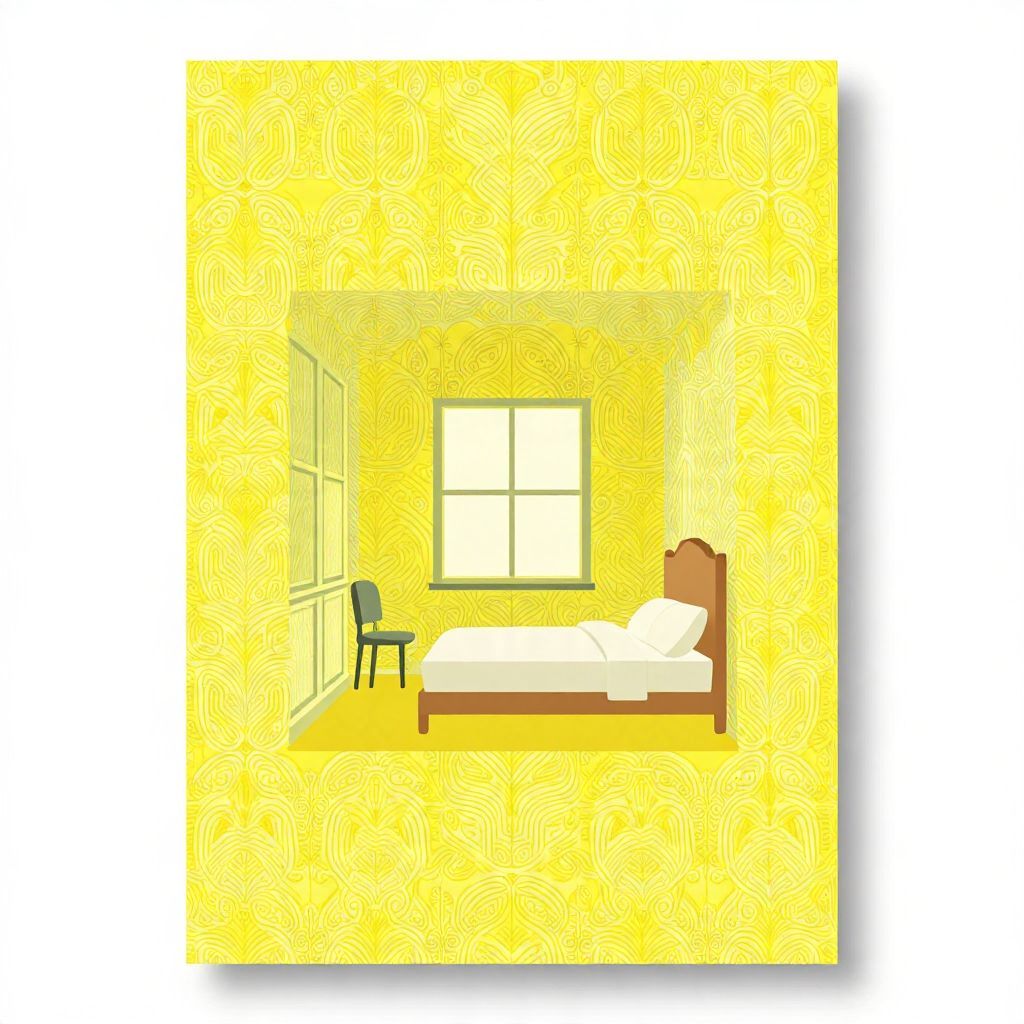
If you’re wondering what The Yellow Wallpaper is about, the short answer is that it’s a haunting short story about a woman’s mental and emotional breakdown while she is confined to a room under the care of her husband. Written by Charlotte Perkins Gilman, it is also a sharp critique of the “rest cure” and of how women’s experiences were often dismissed.
The story is brief, but its meaning is layered. It can be read as a psychological portrait, a feminist text, a Gothic tale, and a study of unreliable narration all at once.
What Is The Yellow Wallpaper About?
The Yellow Wallpaper is about a woman’s descent into obsession and distress after being isolated in a room with disturbing wallpaper, while her husband insists that rest will cure her nervous condition. On the surface, it is a story of illness and confinement; underneath, it is an indictment of medical and marital power that strips the narrator of agency and voice.
Plot Overview Without Losing the Meaning
The unnamed narrator has been taken to a rented country house for the summer. Her husband, John, who is also her physician, believes she should avoid work, writing, and mental exertion. He places her in a former nursery, and she gradually becomes fixated on the room’s wallpaper.
At first, the wallpaper seems merely ugly and irritating. As the days pass, the narrator begins to see patterns in it, then movement, then a trapped woman behind it. Her obsession intensifies as her own sense of reality becomes less stable, until the distinction between the wallpaper’s imagined figure and her own condition becomes deeply unsettling.
Why the plot feels so disturbing
The story is effective because the external action is minimal. Most of the tension comes from the narrator’s private thoughts, which the reader experiences directly through her journal-like voice.
That intimacy makes the story more than a simple “madness” narrative. It becomes a record of pressure, silencing, and psychological strain.
Who Wrote It and Why It Matters
The Yellow Wallpaper was written by Charlotte Perkins Gilman, an American writer and social critic. The story first appeared in 1892 and is now one of the best-known works of American short fiction.
Gilman is often associated with feminist literature because her work repeatedly examines women’s labor, confinement, and dependence. This story is especially famous because it draws on the medical practices of its time, including the “rest cure,” which prescribed isolation and inactivity for women diagnosed with nervous disorders.
Historical context
Readers often approach the story as both fiction and social commentary. Its power comes partly from the fact that the narrator’s treatment reflects real attitudes toward women’s mental health in the late 19th century.
That context helps explain why the story feels so precise in its critique. The problem is not only the wallpaper; it is the system that keeps the narrator from naming her own needs.
Main Themes in The Yellow Wallpaper
1. Confinement and control
The narrator is physically confined to a room, but the deeper confinement is social and psychological. She is monitored, corrected, and denied meaningful self-expression.
The room becomes a symbol of domestic imprisonment, showing how a supposedly safe space can become oppressive when power is unequal.
2. Women’s silencing
One of the story’s central concerns is the dismissal of women’s perceptions. The narrator repeatedly senses that something is wrong, but John treats her observations as irrational.
This dynamic makes the story especially important in feminist literary studies. The narrator’s voice is present throughout, yet it is continually undermined by the authority around her.
3. Mental health and misdiagnosis
The story is often read as a depiction of postpartum depression, anxiety, or psychosis, though the text does not provide a clinical diagnosis. What it clearly shows is the danger of treating emotional suffering as something that can simply be ignored or disciplined away.
Gilman’s story does not reduce mental illness to a single cause. Instead, it suggests that environment, isolation, and lack of autonomy can worsen distress dramatically.
4. The conflict between appearance and reality
The wallpaper is ugly, confusing, and unstable in the narrator’s mind, but it also becomes a screen for her deeper fears and frustrations. The story keeps asking whether the pattern is “really” changing or whether the narrator’s mind is changing.
That uncertainty is part of the story’s literary strength. It creates a tension between literal and symbolic meaning that never fully resolves.
Key Characters and Their Roles
The narrator
The narrator is unnamed, which reinforces how little personal authority she is allowed. Her voice is vivid, intelligent, and increasingly fragmented, and the story depends on the reader noticing both her insight and her distress.
She is not simply a passive victim. Her private observations become the only space where resistance can emerge, even if that resistance turns inward and obsessive.
John
John is the narrator’s husband and physician. He is affectionate in tone but controlling in practice, and he represents the authority that defines the narrator’s condition for her.
He is not written as a melodramatic villain. Instead, his calm certainty makes him more disturbing, because his care is inseparable from domination.
Jennie
Jennie, John’s sister, helps manage the household and appears practical, tidy, and compliant. She functions as a contrast to the narrator, showing what socially approved domestic behavior looks like within the story’s world.
She also reinforces the narrator’s isolation, even when she seems kind or helpful.
Symbols and Literary Devices
The wallpaper
The wallpaper is the story’s central symbol. On one level, it is simply an unpleasant object in a bad room; on another, it becomes a projection of the narrator’s trapped state.
Its chaotic pattern mirrors her mental confusion, while the figure she sees behind it suggests a hidden self struggling to break free.
The room
The room itself is a symbol of confinement disguised as care. It resembles a nursery, which adds an unsettling layer: the adult woman is treated like a child.
That detail deepens the story’s critique of paternalism, or the assumption that authority knows best simply because it is authoritative.
Unreliable narration
The narrator’s perspective is limited and increasingly unstable, which makes the story a classic example of unreliable narration. Readers must interpret events through a voice that is both emotionally immediate and potentially distorted.
This technique does not make the narrator unimportant; it makes her experience central. The instability of the narration is part of the story’s meaning.
Imagery and repetition
Gilman uses repeated references to color, pattern, movement, and enclosure to build psychological pressure. The prose becomes more intense as the narrator’s fixation grows.
That repetition helps the reader feel the narrowing of her world. The story’s style enacts the very obsession it describes.
Why the Story Is Considered a Literary Classic
The Yellow Wallpaper endures because it is compact, unsettling, and open to multiple interpretations. It can be studied as a Gothic story, a feminist text, a psychological narrative, or a critique of medical authority.
It is also a strong example of how a short story can carry a large social argument. Gilman turns a private domestic setting into a powerful commentary on power, language, and identity.
Common ways readers interpret the ending
Many readers see the ending as a breakdown, but others see it as a form of rebellion, however tragic. The narrator’s final actions can be read as a desperate attempt to claim freedom from the roles imposed on her.
Because the story is so carefully layered, both readings can coexist. That ambiguity is one reason it remains widely taught and discussed.
What to Notice When You Read It
- How often the narrator is interrupted or corrected by John and others.
- How the room changes in her mind as her isolation deepens.
- The difference between what the narrator says aloud and what she writes privately.
- How the wallpaper becomes a symbol of both oppression and projection.
- The story’s shift in tone from uneasy observation to intense fixation.
Similar Books and Why Readers Often Compare Them
Readers who respond to The Yellow Wallpaper often enjoy other works that explore confinement, unreliable narration, or psychological unease. The story is especially close in spirit to literature that examines domestic pressure and the inner life of women.
- Psychological fiction that focuses on a narrator’s unstable perspective.
- Gothic literature with claustrophobic settings and eerie symbolism.
- Feminist classics that question gender roles and authority.
If you want a related close reading, you may also enjoy this guide to what The Yellow Wallpaper is about and this article on How Does It Feel.
In short: The Yellow Wallpaper is about a woman’s confinement, her worsening mental state, and the destructive effects of being denied autonomy. It is a short story, but its symbolism, style, and historical context give it lasting literary power.