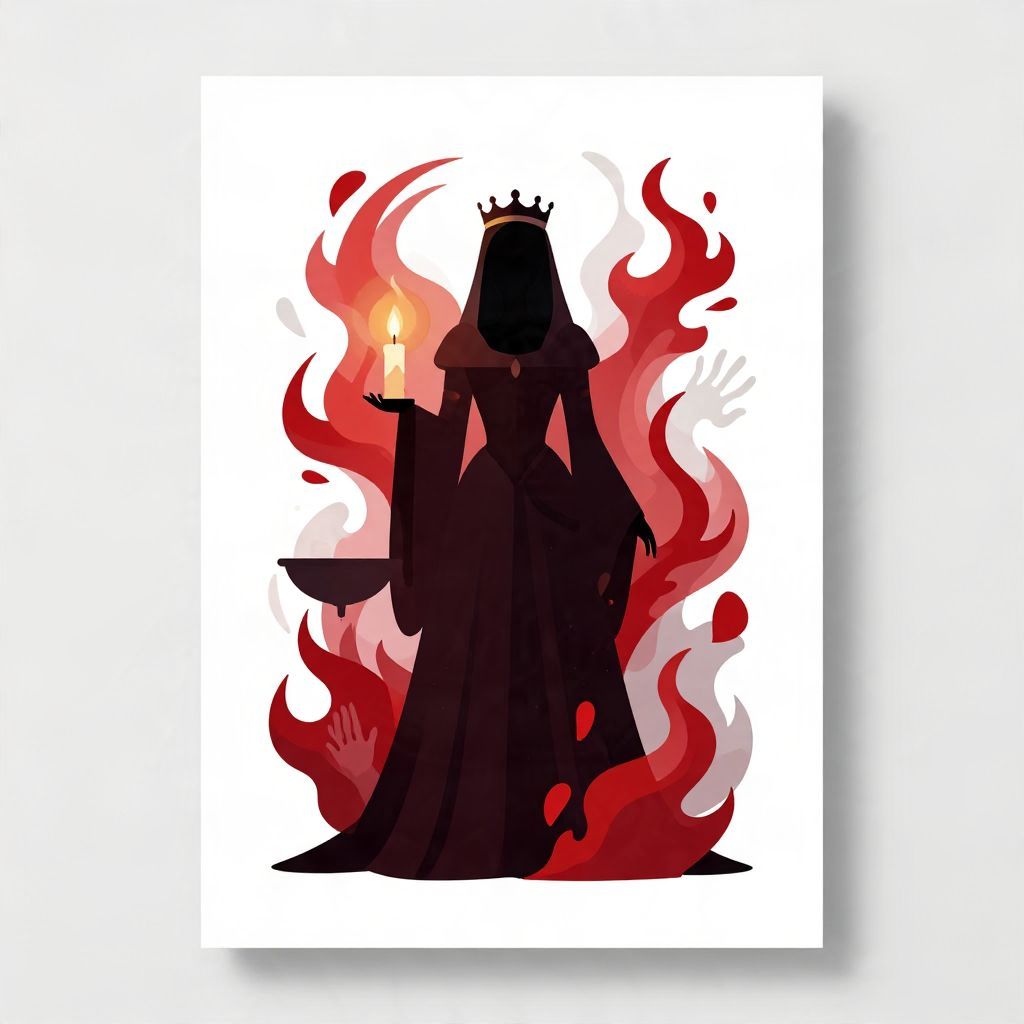
If you’re asking “How does Lady Macbeth die?” you’re probably looking for the ending of Macbeth and what her death means in Shakespeare’s tragedy. The short answer is that she dies offstage, apparently by suicide, after her guilt and sleepwalking have shown how deeply the murders have fractured her mind.
Her death is not just a plot point. It closes one of Shakespeare’s most haunting portraits of ambition, conscience, and psychological collapse.
How does Lady Macbeth die in Macbeth?
Lady Macbeth dies offstage before the final battle ends, and the play strongly suggests suicide, though Shakespeare does not show or confirm the act directly. Her death is reported by others, making it part of the tragedy’s atmosphere of silence, guilt, and emotional ruin rather than a dramatic scene onstage.
What happens to Lady Macbeth before her death?
Before she dies, Lady Macbeth becomes one of Shakespeare’s clearest examples of guilt turning inward. At first, she seems stronger and more ruthless than Macbeth, urging him to seize the crown through murder. But after Duncan’s death, her composure begins to break down.
The sleepwalking scene
Her decline becomes visible in the famous sleepwalking scene. While asleep, she relives the murders through fragments of speech and compulsive hand-washing, as if trying to scrub away the blood she cannot physically see but psychologically cannot escape.
This scene matters because it reverses her earlier confidence. The woman who once mocked weakness now appears fragile, haunted, and divided against herself.
Why her guilt matters
Lady Macbeth’s death is closely tied to the play’s moral structure. Shakespeare presents guilt not as a simple emotion but as a force that invades the body, disturbs sleep, and destroys the mind. Her death follows that pattern: the crimes she helped set in motion return to consume her from within.
Is Lady Macbeth’s death shown onstage?
No. Shakespeare keeps her death offstage, which is significant in itself. In tragedy, offstage deaths often heighten mystery and emotional distance, forcing the audience to imagine the final act rather than witness it directly.
This choice also fits Lady Macbeth’s role in the play. She is a powerful speaker and strategist early on, but by the end she is isolated from the action. Her death is reported, not performed, emphasizing how completely she has been cut off from the world around her.
What does Lady Macbeth’s death mean?
Lady Macbeth’s death symbolizes the collapse of the illusion that ambition can be controlled. She and Macbeth believe they can force fate, manage appearances, and silence conscience, but the play shows that violence breeds instability. Her death is the final proof that the crime has poisoned both mind and household.
Guilt and psychological disintegration
One of the play’s central themes is that guilt does not disappear after the murder. It changes form. For Lady Macbeth, it becomes insomnia, compulsive speech, and mental unraveling. Her death completes that arc, suggesting that the human cost of the crime is not only political but deeply personal.
Isolation
Another important meaning lies in isolation. Lady Macbeth begins the play as Macbeth’s partner in ambition, but by the end she is alone with her thoughts. Her death underscores how the pursuit of power destroys intimacy and leaves the characters spiritually abandoned.
Lady Macbeth as a character
Lady Macbeth is one of Shakespeare’s most complex characters because she is neither simply villainous nor simply victimized. She is decisive, persuasive, and fiercely ambitious, yet she is also vulnerable to the consequences of the violence she helps unleash.
Her early strength
At the start, she appears more resolute than Macbeth. She questions his courage, challenges his hesitation, and pushes him toward action. In many readings, she becomes the engine of the first murder, not because she commits it herself, but because she helps make it psychologically possible.
Her later fragility
Later, however, Shakespeare complicates that image. Her collapse suggests that strength built on denial cannot last. She may seem invulnerable at first, but the play gradually reveals that she has only suppressed conscience, not escaped it.
That tension is part of what makes her death so powerful. It is not a sudden punishment but the endpoint of a slow inner breakdown.
Key themes connected to Lady Macbeth’s death
- Ambition: The desire for power drives the tragedy, and Lady Macbeth’s death shows the cost of pursuing it through murder.
- Guilt: Her sleepwalking and death reflect the inescapable return of conscience.
- Appearance vs. reality: The couple tries to hide their crimes, but the mind reveals what the body conceals.
- Gender and power: Lady Macbeth challenges expectations of femininity, then becomes a tragic figure shaped by the limits of that challenge.
- Isolation: The play ends with emotional separation as well as political defeat.
Important symbols around her death
Shakespeare uses recurring images to connect Lady Macbeth’s death to the larger tragedy.
Blood
Blood is the most obvious symbol. At first it represents the literal murder of Duncan, but later it becomes a mental stain. Lady Macbeth’s famous hand-washing shows that the blood is no longer physical; it has become psychological and moral.
Sleep
Sleep in Macbeth often stands for innocence, peace, and restoration. Lady Macbeth’s sleepwalking suggests that even rest is no longer safe. Her mind replays the crime when she should be unconscious, as if guilt has invaded the one place where she might have escaped it.
Darkness
Darkness in the play frequently accompanies secrecy and moral confusion. Lady Macbeth’s death belongs to that world of obscurity: it happens offstage, in a space where certainty is limited and the audience must infer the final truth.
How Shakespeare uses language in Lady Macbeth’s arc
Shakespeare gives Lady Macbeth some of the play’s most forceful language early on. Her speech is direct, commanding, and filled with imperatives. That verbal control helps establish her as a character who believes she can master events through willpower alone.
As the play progresses, her language fragments. In the sleepwalking scene, she no longer speaks in polished persuasion but in broken images and obsessive repetition. That shift is one of Shakespeare’s most effective dramatic techniques, showing inner collapse through speech itself.
Why Lady Macbeth’s death still resonates
Lady Macbeth remains compelling because her death is neither triumphant nor neatly moralized. Shakespeare does not reduce her to a simple warning against ambition. Instead, he presents a character whose intelligence, force, and vulnerability all contribute to her downfall.
Her death resonates because it feels tragically human. She helps create the violence, but she also suffers from it. The play invites readers to see that guilt can outlast power, and that the mind may become the final battlefield after the political struggle is over.
Book summary and review perspective
If you are reading Macbeth for study or general interest, Lady Macbeth’s death is best understood as the emotional climax of her character arc. It is not simply the end of a plotline; it is the moment when the play’s themes of ambition, conscience, and psychological damage come fully into focus.
As a tragedy, Macbeth remains striking because it compresses enormous consequences into a relatively short play. Lady Macbeth’s death, especially because it is unseen, leaves a lingering silence that feels more disturbing than a staged death might have.
Quick answer: what should readers remember?
Lady Macbeth dies offstage in Macbeth, and the play strongly implies suicide. Her death follows her mental collapse, especially the sleepwalking scene, and it serves as a tragic conclusion to the guilt and violence she helped unleash.
If you’re interested in other Shakespearean or tragic deaths in literature, you may also like how Juliet dies and how Catherine dies in Wuthering Heights.