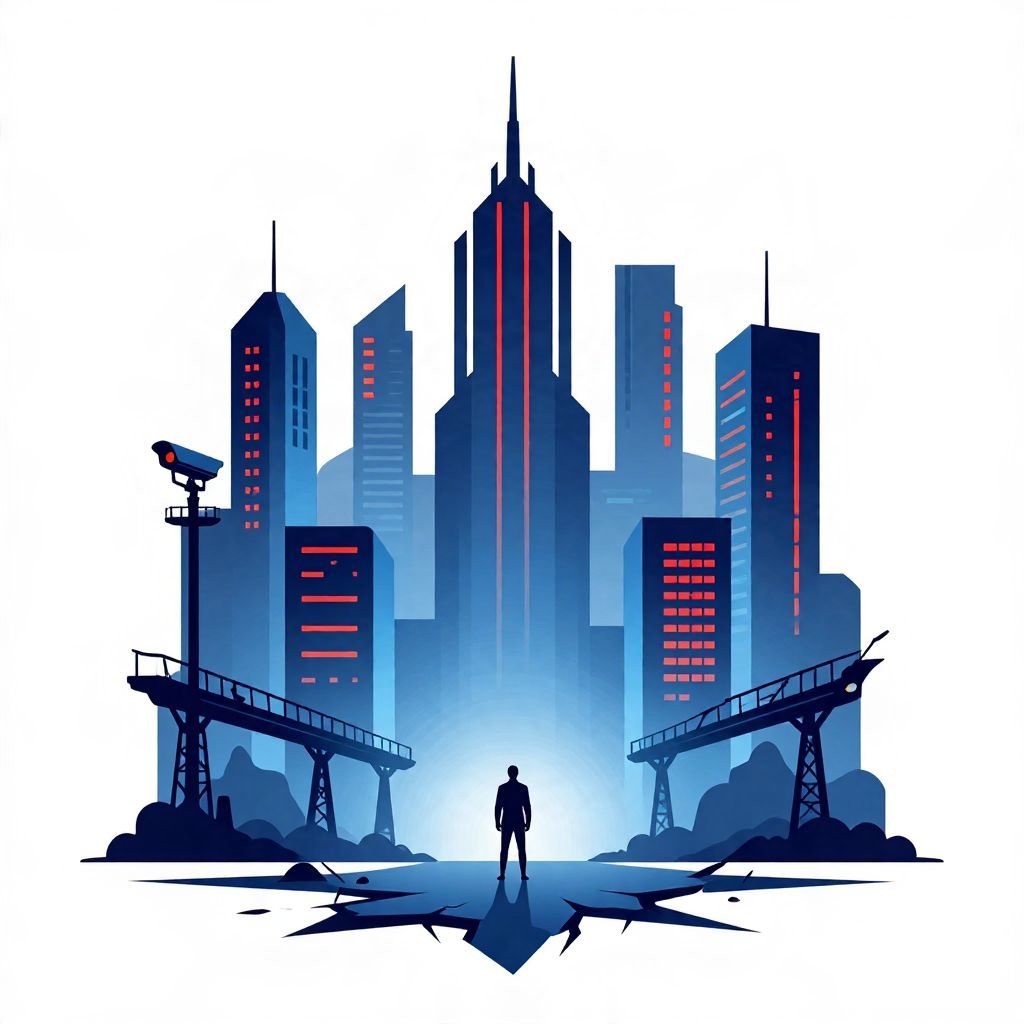
If you’ve ever wondered why so many novels imagine ruined cities, oppressive governments, and people fighting to stay human, you’re asking about one of literature’s most enduring forms. Dystopian fiction turns a frightening version of the future into a story about power, freedom, and survival.
It is both a warning and a thought experiment: what happens when a society’s worst tendencies are taken to their logical extreme? That question has made dystopian stories especially resonant in periods of political anxiety, technological change, and social unrest.
What is dystopian fiction?
Dystopian fiction is a genre that presents an imagined society in which life is deeply flawed, oppressive, or dehumanizing, often under the control of a powerful state, corporation, ideology, or system. Unlike a simple disaster story, dystopian fiction focuses on the structure of society itself and on how ordinary people live under its rules, surveillance, and restrictions.
How does dystopian fiction differ from utopian fiction?
Dystopian fiction is often easiest to understand as the dark counterpart to utopian fiction. A utopia imagines an ideal society; a dystopia reveals what can go wrong when ideals become rigid, authoritarian, or exclusionary.
Key difference in purpose
- Utopian fiction asks how society might be improved.
- Dystopian fiction asks what happens when control, inequality, or fear shape society to the breaking point.
- Both genres often use imagined worlds to comment on the present.
Not just “bad futures”
A dystopia is not simply a future with ruined buildings or advanced technology gone wrong. The core concern is usually social: censorship, propaganda, class division, environmental collapse, forced conformity, or the loss of privacy and autonomy.
What are the main features of dystopian fiction?
Dystopian stories vary widely, but they often share several recognizable features. These elements help create the genre’s tense atmosphere and its moral urgency.
1. An oppressive social order
The setting usually includes a government or system that controls behavior through fear, surveillance, propaganda, or violence. Even when the ruling power is not a traditional state, the society still limits freedom in disturbing ways.
2. Restricted individual choice
Characters often cannot choose where to live, what to read, whom to love, or how to speak. This loss of agency is central to the genre’s emotional force.
3. A divided society
Many dystopias are organized around sharp inequalities. Some people enjoy comfort and privilege while others are monitored, exploited, or discarded.
4. A protagonist who questions the system
The main character is often someone who begins to notice contradictions in the world around them. Their growing awareness gives the reader a way into the society’s hidden cruelty.
5. A warning about the present
Dystopian fiction usually reflects contemporary fears. It may respond to war, totalitarianism, consumer culture, environmental damage, censorship, or the misuse of science and technology.
What themes are common in dystopian fiction?
Because the genre is so flexible, dystopian fiction can address many different concerns. Still, a few themes appear again and again across classic and modern works.
- Freedom versus control
- Surveillance and privacy
- Propaganda and truth
- Conformity versus individuality
- Class inequality and social division
- Technology and dehumanization
- Environmental collapse
- Resistance, rebellion, and hope
Some dystopian novels end in tragedy, while others leave room for resistance or change. Even when the ending is bleak, the act of imagining dissent can itself be a form of hope.
A brief history of dystopian fiction
The roots of dystopian fiction stretch back further than many readers expect. Writers have long imagined flawed societies as a way to critique politics, morality, and human nature.
Early influences
Earlier works of political satire and speculative writing helped shape the genre, but dystopian fiction became especially prominent in the 20th century, when wars, authoritarian regimes, mass propaganda, and rapid industrial change sharpened public fears.
20th-century classics
Many of the best-known dystopian novels emerged in response to totalitarianism, censorship, and the pressure to conform. These books helped define the genre’s modern form and established many of its recurring concerns.
Among the most influential are:
- We by Yevgeny Zamyatin
- Brave New World by Aldous Huxley
- Nineteen Eighty-Four by George Orwell
- Fahrenheit 451 by Ray Bradbury
Later dystopian fiction expanded beyond political dictatorship to include ecological collapse, corporate power, genetic engineering, and digital surveillance.
Why is dystopian fiction so popular?
Dystopian fiction remains popular because it transforms abstract anxieties into vivid stories. Readers can see how a society works, who benefits from it, and what it costs ordinary people.
It makes social criticism concrete
Rather than arguing in general terms, dystopian fiction dramatizes the consequences of bad systems. That makes its warnings memorable and emotionally immediate.
It gives shape to fear
Many readers are drawn to dystopian fiction because it names fears that can feel diffuse in real life: loss of privacy, political manipulation, climate instability, or the sense that institutions no longer serve the public good.
It centers resistance
Even in grim settings, dystopian fiction often follows characters who question authority, preserve memory, or protect human connection. That struggle can be deeply compelling.
What literary techniques are common in dystopian fiction?
Dystopian fiction often relies on specific literary techniques to make its imagined worlds feel convincing and unsettling.
World-building
Writers carefully construct laws, customs, technologies, and social hierarchies so the reader can understand how the society functions. Strong world-building makes the setting feel coherent rather than merely decorative.
Irony
Many dystopias are built on irony: a government claims to create peace, safety, or equality, yet produces fear and oppression instead. The gap between promise and reality is often central to the novel’s meaning.
Symbolism
Objects, places, and routines often carry symbolic weight. A wall may represent isolation, a screen may suggest surveillance, and a banned book may stand for memory or intellectual freedom.
Restricted perspective
Some novels limit the reader’s knowledge to what the protagonist sees or understands. This can intensify suspense and mirror the confusion of living inside a controlled system.
Satire and exaggeration
Not all dystopian fiction is grim in tone. Some works use exaggeration, dark humor, or satire to expose the absurdity of political and social systems.
What are some famous literary examples of dystopian fiction?
Many books could fit the genre, but a few have become especially important in literary study and classroom discussion. These examples show how broad dystopian fiction can be.
Nineteen Eighty-Four by George Orwell
Orwell’s novel is one of the clearest portraits of surveillance, propaganda, and state control in modern literature. It remains influential because it captures how language and fear can be used to shape reality.
Brave New World by Aldous Huxley
Huxley imagines a society that maintains order not through terror alone, but through pleasure, conditioning, and distraction. The novel is often read as a warning about the cost of comfort without freedom.
Fahrenheit 451 by Ray Bradbury
Bradbury’s novel focuses on censorship, anti-intellectualism, and the destruction of books. It is especially powerful as a meditation on how easily a culture can lose its memory and critical habits.
The Handmaid’s Tale by Margaret Atwood
Atwood’s novel explores theocratic control, reproductive oppression, and the use of ritual to enforce power. Its impact comes partly from the way it links political domination to intimate aspects of daily life.
The Hunger Games by Suzanne Collins
Although often discussed as young adult fiction, this series is also a major modern dystopian example. It examines spectacle, inequality, and the manipulation of violence for public entertainment.
How should readers approach dystopian fiction?
Dystopian fiction rewards close reading because its imagined worlds are rarely random. Details about language, architecture, rituals, and technology often reveal the values of the society and the pressures placed on its characters.
Questions to ask while reading
- Who has power, and how is that power maintained?
- What does the society fear most?
- What is forbidden, and why?
- How are truth and memory controlled?
- What counts as resistance in this world?
These questions can help readers move beyond the surface plot and see the genre’s deeper political and philosophical concerns.
Why does dystopian fiction still matter?
Dystopian fiction matters because it asks readers to examine the present through the lens of the imagined future. Its best works do not predict the future so much as expose the dangers already present in society.
That is why the genre continues to feel urgent. Whether it is warning about censorship, inequality, environmental collapse, or the loss of human dignity, dystopian fiction reminds us that societies are shaped by choices—and that those choices can be challenged.
If you’d like to explore the genre further, you may also enjoy what a dystopian novel is and the discussion of why Fahrenheit 451 is banned.