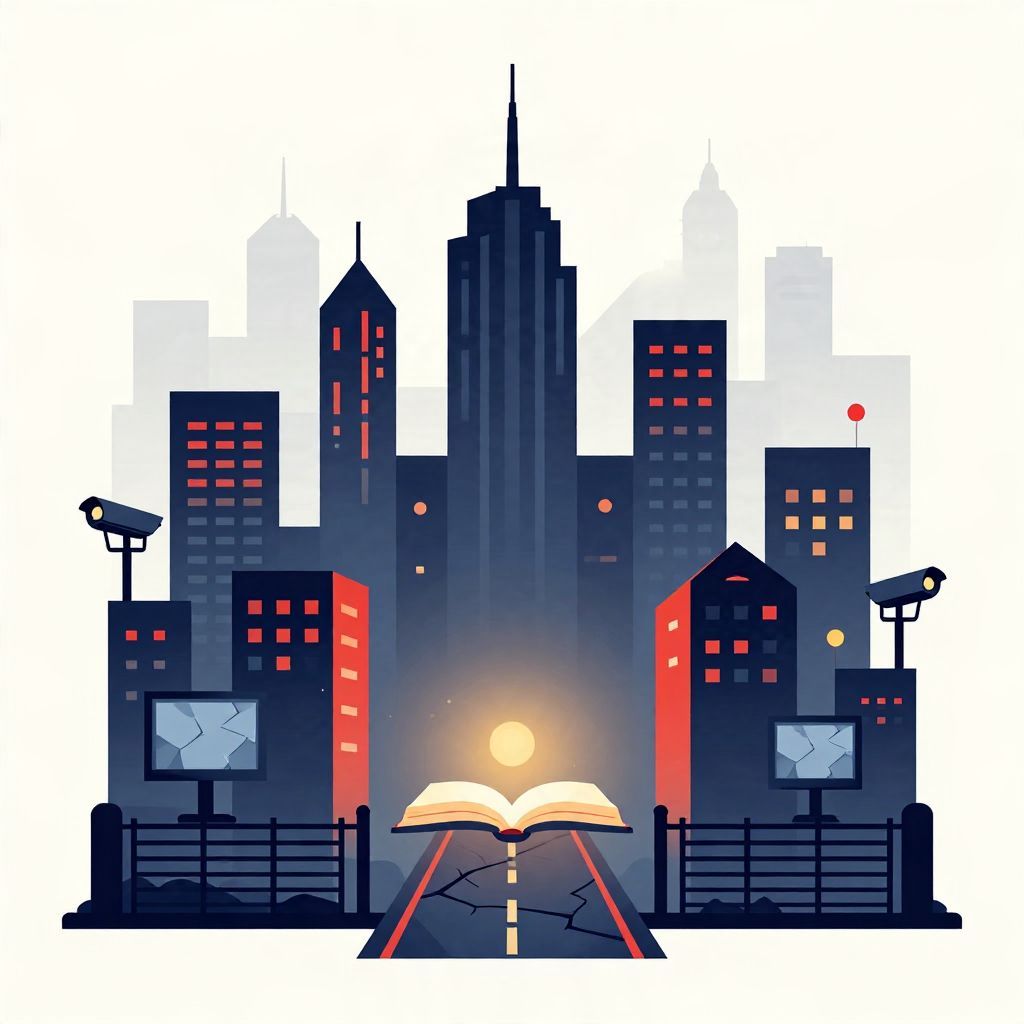
If you’ve ever wondered why some novels feel unsettlingly close to real life, you’re probably thinking about dystopian fiction. These stories imagine societies shaped by oppression, surveillance, environmental collapse, or rigid control, and they often use that imagined future to comment on the present.
A dystopian novel is a work of fiction set in a flawed or nightmarish society, usually one that appears orderly on the surface but is deeply unjust underneath. The genre explores power, freedom, conformity, and resistance, often warning readers about political, technological, or social extremes.
What is a dystopian novel?
A dystopian novel is a story set in a society where life is deliberately distorted by control, fear, inequality, or dehumanization. Unlike utopias, which imagine ideal communities, dystopias show what happens when systems meant to protect people become oppressive or destructive.
How dystopian fiction works
Dystopian novels usually begin with a world that feels organized, efficient, or safe, then reveal the cost of that order. The society may restrict speech, monitor citizens, divide people into classes, or erase personal choice in the name of stability.
Many dystopian stories are not mainly about the future itself. They use imagined worlds as a mirror, exaggerating real-world anxieties about government power, propaganda, mass surveillance, consumerism, war, environmental damage, or social inequality.
Common features of dystopian novels
- Authoritarian control: Authorities limit freedom through force, law, or ideology.
- Loss of individuality: Characters are pressured to conform or surrender identity.
- Surveillance or censorship: Privacy, truth, and language are controlled.
- Social division: People are separated by class, caste, rank, or usefulness.
- Resistance: A character or group questions the system and seeks change.
What themes do dystopian novels explore?
Dystopian fiction is especially interested in the relationship between the individual and the system. It asks what happens when institutions demand obedience, when truth becomes unstable, or when moral choices become dangerous.
Power and control
Many dystopian novels examine how power is maintained through fear, propaganda, and punishment. The point is not only that leaders are cruel, but that systems can make cruelty seem normal or necessary.
Freedom and conformity
These stories often center on characters who begin to question rules everyone else accepts. Their struggle highlights how difficult it can be to think independently in a culture that rewards sameness.
Language and truth
Language is often a major concern in dystopian fiction because controlling words can mean controlling thought. When language is narrowed, slogans replace argument, and facts become propaganda, people lose the tools needed to resist.
Technology and surveillance
Some dystopian novels focus on machines, data, or monitoring systems that make privacy impossible. In these stories, technology is not automatically evil, but it becomes dangerous when used to track, sort, predict, or discipline human behavior.
Environment and survival
Other dystopias arise from ecological collapse, scarcity, or climate disaster. These books ask how societies change when resources are limited and survival is unevenly distributed.
What makes a novel dystopian rather than simply dark?
Not every bleak or tragic novel is dystopian. A dystopian novel usually presents a whole social order that is fundamentally damaged, not just a difficult personal situation. The setting itself is part of the argument the book is making.
In other words, the genre is defined by systemic oppression. A grim atmosphere alone is not enough; the world must be structured in a way that reveals a warning about society, politics, or human behavior.
Literary techniques often used in dystopian novels
Dystopian writers rely on craft choices that make the world feel both believable and disturbing. The style may be spare and controlled, or sharply ironic, depending on the effect the author wants.
World-building
Careful world-building helps readers understand how the society functions. Small details about food, rules, clothing, housing, or public rituals can reveal how deeply control reaches into everyday life.
Symbolism
Objects, places, and routines often carry symbolic meaning. A wall, a uniform, a screen, a ration card, or a forbidden book may stand for isolation, obedience, scarcity, or the fragile survival of memory.
Irony and satire
Some dystopian novels use irony to expose the gap between official claims and lived reality. Satirical dystopias can be especially effective because they show how absurd oppressive systems can become when taken to their logical extreme.
Restricted point of view
Many dystopian novels are told through a limited perspective, which helps readers discover the society gradually. This can create suspense and also reflect how hard it is for characters to see beyond the rules they have been taught.
A brief literary history of dystopian fiction
Dystopian writing developed alongside modern anxieties about industrialization, mass politics, war, and technology. While earlier literature included imagined ideal societies, the modern dystopian novel emerged as writers began to question whether progress always leads to human improvement.
In the twentieth century, dystopian fiction became especially prominent because of totalitarian regimes, world wars, propaganda, and rapid technological change. These historical pressures helped shape some of the genre’s best-known works and made the warning function of dystopia especially powerful.
Well-known literary examples of dystopian novels
If you want to understand the genre, it helps to look at a few major examples. These books differ in style and setting, but each shows how dystopian fiction can warn, provoke, and unsettle readers.
1984 by George Orwell
Orwell’s novel is one of the most influential dystopian works ever written. It imagines a state built on surveillance, propaganda, and the manipulation of truth, with language itself becoming a tool of control.
The book remains central to discussions of censorship, political repression, and the fragility of independent thought. It is often cited because it shows how authoritarian power can reach into memory, speech, and private life.
Brave New World by Aldous Huxley
Huxley’s novel presents a society that appears peaceful and efficient, but only because individuality, deep emotion, and freedom have been sacrificed. Rather than ruling through terror alone, this world uses pleasure, conditioning, and distraction.
It is a key dystopian text because it asks whether comfort can become its own form of control. The novel remains relevant in conversations about consumer culture, engineered happiness, and social conformity.
The Handmaid’s Tale by Margaret Atwood
Atwood’s novel imagines a theocratic regime that strips women of autonomy and reduces them to reproductive roles. Its power comes from the way it combines political oppression with intimate, bodily control.
The book is often read as a warning about authoritarianism, gender oppression, and the vulnerability of rights that seem secure until they are taken away. Its influence has made it one of the most discussed dystopian novels in contemporary literature.
Fahrenheit 451 by Ray Bradbury
Bradbury’s novel centers on a culture where books are banned and critical thought is discouraged. It examines censorship, distraction, and the social cost of avoiding uncomfortable ideas.
The novel is especially useful for readers interested in how entertainment, fear, and anti-intellectualism can work together to weaken public life. Its focus on fire and books makes its symbolism immediately memorable.
Animal Farm by George Orwell
Although often taught as an allegory, Animal Farm also belongs to the broader tradition of dystopian writing because it shows how revolutionary ideals can be corrupted into another form of domination. The farm’s promise of equality collapses into hierarchy and manipulation.
Its lasting value lies in its clarity: it demonstrates how language, slogans, and power can reshape a political movement until it serves the interests of the few rather than the many.
How dystopian novels differ from related genres
Dystopian fiction overlaps with science fiction, speculative fiction, and political allegory, but it is not identical to any of them. The genre is defined less by setting than by the social warning at its center.
Dystopian vs. utopian fiction
Utopian fiction imagines an ideal society, while dystopian fiction imagines a damaged one. Some books blur the line by showing that a seemingly perfect society depends on hidden violence or sacrifice.
Dystopian vs. post-apocalyptic fiction
Post-apocalyptic stories take place after a collapse, whereas dystopian novels often show a functioning society that is already oppressive. A post-apocalyptic world can become dystopian, but the terms are not interchangeable.
Dystopian vs. science fiction
Many dystopian novels are science fiction, especially when they involve advanced technology or future settings. Still, a novel can be dystopian without being heavily technological, as long as its social order is deeply unjust.
Why readers are drawn to dystopian novels
Dystopian fiction can be disturbing, but it is also clarifying. By exaggerating social problems, it helps readers recognize patterns they may otherwise overlook in everyday life.
These novels also offer a form of imaginative resistance. Even when they end bleakly, they often preserve the idea that truth, memory, empathy, or dissent still matter.
Good reasons to read dystopian fiction
- It sharpens your understanding of politics and power.
- It encourages close reading of symbolism and theme.
- It connects literature to current social debates.
- It raises ethical questions about freedom, safety, and responsibility.
How to read a dystopian novel closely
If you are reading a dystopian novel for class or personal interest, pay attention to the rules of the world and how characters respond to them. The most revealing moments often come from small acts of disobedience, silence, or memory.
- Notice what the society values most: order, obedience, efficiency, purity, or stability.
- Track what is restricted: language, movement, relationships, knowledge, or privacy.
- Look for symbols that repeat, especially objects linked to control or resistance.
- Ask how the narrator’s perspective shapes what the reader learns.
- Consider what real-world concern the novel may be warning about.
Final takeaway
A dystopian novel is more than a dark story set in the future. It is a literary warning about what can happen when power goes unchecked and human freedom is treated as expendable. If you want to explore more book-related analysis, you may also enjoy who Moses represents in Animal Farm and this related book and literature article.