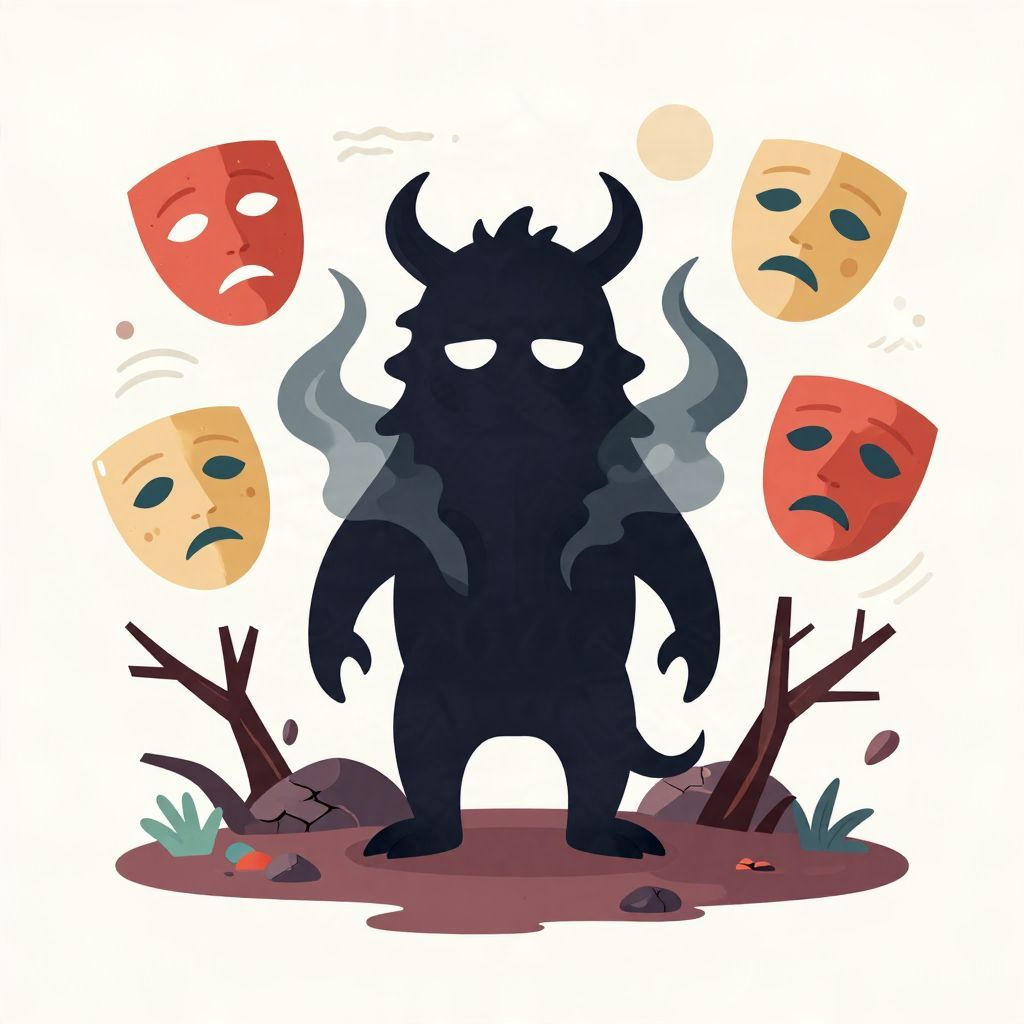
If you’re asking what the beast symbolizes in Lord of the Flies, you’re really asking what kind of fear Golding thinks lives inside people. The answer is not a simple monster hiding on the island. The beast becomes a symbol of the boys’ growing terror, their loss of innocence, and the darkness they begin to recognize in themselves.
That symbolic meaning changes as the novel develops. At first it seems like a childish fear of something external, but Golding gradually shows that the real threat is internal: panic, violence, and the desire to dominate others.
What does the beast symbolize in Lord of the Flies?
The beast symbolizes the boys’ inner fear and the savage impulses that emerge when social rules disappear. It also represents the unknown, the breakdown of reason, and the human capacity for evil. Golding uses the beast to show that the most frightening force on the island is not an animal, but the darkness within the boys themselves.
Why the beast matters in the novel
Golding does not present the beast as a single, fixed thing. Instead, it shifts shape depending on who is imagining it, which makes it a powerful literary symbol rather than just a plot device.
Fear made visible
The boys cannot name their anxieties clearly, so they give them a body. The beast becomes a way to talk about fear in a form they can picture, chase, and blame.
That matters because fear spreads quickly on the island. Once the boys believe in the beast, their imagination begins to control their behavior, and fear starts to replace clear thinking.
The loss of innocence
As the boys become more frightened and aggressive, they move farther away from the civilized identities they brought with them. The beast symbolizes that slide from childhood trust into suspicion, cruelty, and chaos.
In that sense, the beast is not only “out there.” It marks the moment when innocence stops protecting the boys from what they are capable of becoming.
The darkness inside human nature
One of the novel’s central ideas is that human beings are not naturally safe or purely good. The beast symbolizes the instinct toward violence, domination, and irrational behavior that emerges when restraint weakens.
This is why the symbol is so unsettling: it suggests that evil does not need an outside source. It can arise from the boys themselves.
How the beast changes meaning throughout the story
Golding develops the beast in stages, and each stage deepens its symbolic meaning. What begins as a rumor becomes a social force, then a political tool, and finally a psychological truth.
At first: a childish fear of the unknown
Early in the novel, the beast is mostly a vague idea. The younger boys are especially vulnerable to it because they do not have the language or confidence to explain what they feel.
At this stage, the beast symbolizes the fear that comes from darkness, isolation, and unfamiliar surroundings.
Then: a shared obsession
As more boys accept the idea of the beast, it becomes part of the group’s collective mindset. The fear is no longer private; it starts shaping the whole community.
Golding shows how shared fear can unite people temporarily, but also make them easier to control.
Later: a tool of power
Jack benefits from the boys’ fear because he can use it to strengthen his authority. The beast becomes politically useful: if the boys are afraid, they are more likely to obey whoever promises protection.
Here, the symbol expands beyond psychology and becomes a comment on leadership, manipulation, and the appeal of authoritarian power.
Finally: the boys themselves
By the end of the novel, the beast is no longer just a story about something outside them. Their actions reveal that the true danger is their own capacity for brutality.
Golding’s point is not that imagination creates evil out of nothing, but that fear can uncover what was already there.
The beast and Simon’s insight
Simon is the character who comes closest to understanding what the beast really means. He recognizes that the fear is tied to the boys themselves, not to a literal creature on the island.
His insight is one of the novel’s most important moments because it shifts the beast from external mystery to internal truth. Golding uses Simon to suggest that clarity is possible, but fragile and easily destroyed by group panic.
Why Simon’s understanding matters
Simon’s perspective shows that the beast is symbolic before the boys can fully admit it. He senses that the real enemy is the violence growing inside the group.
This makes Simon a kind of moral and spiritual counterpoint to the others: he sees the truth, but the others are not ready to hear it.
The beast as a symbol of civilization breaking down
The beast also reflects what happens when the structures of civilization weaken. The boys arrive with rules, routines, and a belief that adults will eventually restore order. As those supports fade, fear fills the gap.
In that context, the beast symbolizes the collapse of rational society. Without shared institutions and disciplined behavior, the boys become more vulnerable to superstition, tribal thinking, and violence.
Order versus chaos
Ralph represents order, planning, and cooperation, while Jack represents instinct, dominance, and excitement. The beast intensifies the conflict between these two forces.
It helps explain why the boys abandon reason: fear is emotionally stronger than logic, especially when survival feels uncertain.
Common interpretations of the beast
Readers often understand the beast in several overlapping ways. These interpretations are not mutually exclusive; Golding’s symbol is effective because it holds more than one meaning at once.
- The boys’ fear: the beast is a projection of anxiety and uncertainty.
- Human savagery: it represents the violent instincts beneath civilized behavior.
- Social breakdown: it stands for the collapse of shared rules and rational order.
- Power and manipulation: it becomes a way to control others through fear.
- The unknown: it also reflects the terror people feel when they cannot explain their surroundings.
These meanings work together rather than competing with one another. That layered symbolism is part of what makes the novel so enduring in classrooms and literary study.
Why Golding uses a beast instead of a direct explanation
Golding could have simply stated that the boys were afraid of themselves, but a symbol is more powerful than a statement. The beast gives shape to an abstract idea and allows the novel to dramatize fear in a vivid, memorable way.
It also mirrors how people often behave in real life. We rarely confront fear as a neat concept; we turn it into stories, enemies, rumors, and myths.
A symbol that grows with the story
The beast works because it is flexible. It can be imagined, discussed, denied, worshipped, and feared, which lets Golding show how a symbol can influence behavior almost like a character.
That flexibility makes it one of the novel’s central literary devices, alongside allegory, irony, and imagery.
What the beast does not symbolize
It is also useful to be precise about what the beast is not. It is not simply a random monster, and it is not just a children’s fear with no deeper meaning.
Golding uses the beast to point toward psychological and moral realities, so reading it as only a literal creature misses the novel’s larger argument.
- It is not just an external animal threat.
- It is not only a superstition among younger boys.
- It is not a single-answer symbol with one fixed meaning.
In one sentence: the beast’s meaning
The beast in Lord of the Flies symbolizes the fear, savagery, and moral darkness that emerge when civilization weakens and people stop trusting reason, empathy, and shared rules.
Takeaway for readers and students
If you are analyzing the novel for class or discussion, the strongest reading is that the beast is both psychological and social: it is the boys’ fear, but also the force that fear creates in the group. Golding uses it to show that the real danger on the island is not a creature in the jungle, but the violence human beings can unleash on one another.
For more close reading help, you may also want to explore what the beast means in Lord of the Flies and how Simon dies in Lord of the Flies.