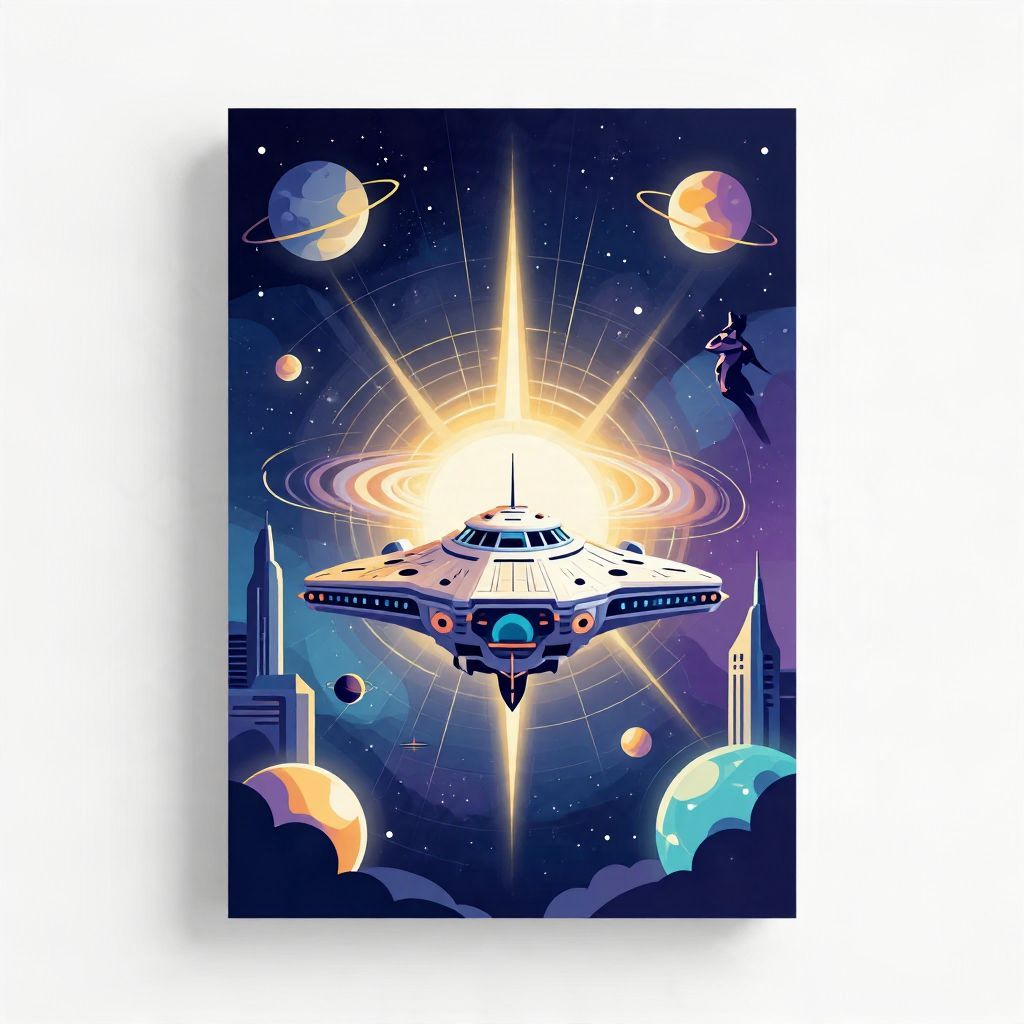
If you’ve ever seen a book described as a “space opera,” you may have wondered what that actually means. The phrase sounds grand and a little playful, and it points to one of science fiction’s most expansive subgenres.
In simple terms, a space opera is a type of science fiction that emphasizes sweeping adventures, interstellar settings, dramatic conflicts, and larger-than-life characters. It often blends fast-paced plotting with romance, politics, war, and exploration across planets or star systems.
What is a space opera in literature?
A space opera is a science fiction story set on a large cosmic scale, usually involving interplanetary travel, epic stakes, and emotional drama. Unlike hard science fiction, it is less concerned with scientific realism and more interested in adventure, spectacle, conflict, and character-driven storytelling.
Where did the term “space opera” come from?
The term emerged in the early 20th century as a playful, sometimes dismissive label. It echoed older genre terms like “soap opera” and “horse opera,” suggesting a formulaic but energetic kind of entertainment. Over time, however, writers and readers embraced the term as a proud description of ambitious science fiction.
From pulp adventure to modern epic
Space opera grew out of pulp magazines and early science fiction serials, where readers followed daring heroes through alien worlds, galactic empires, and perilous rescues. Later writers expanded the form, giving it greater psychological depth, political complexity, and stylistic sophistication.
What are the main features of a space opera?
Space opera is defined less by one fixed formula than by a cluster of recognizable traits. These stories often combine high stakes with vivid worldbuilding and emotional intensity.
- Large-scale setting: multiple planets, star systems, or galactic civilizations
- Adventure and conflict: wars, rebellions, quests, or political struggles
- Strong character arcs: heroes, antiheroes, dynasties, or rival factions
- Melodramatic energy: betrayal, sacrifice, loyalty, love, and revenge
- Speculative worldbuilding: alien cultures, advanced technology, and imagined social systems
- Accessible momentum: plots that usually move quickly and dramatically
What space opera is not
Space opera is not simply any story set in space. A quiet, realistic astronaut novel, for example, may be science fiction without being space opera. The subgenre usually requires a sense of scale, heightened drama, and a broad, often cinematic sweep.
How does space opera differ from other science fiction?
Space opera sits alongside other science fiction modes but has a different emphasis. It tends to favor story, emotion, and spectacle over technical problem-solving or strict scientific plausibility.
Space opera vs. hard science fiction
Hard science fiction focuses on scientific accuracy, engineering, and plausible extrapolation. Space opera may use faster-than-light travel, giant empires, or improbable technologies as narrative tools, treating them as part of the imaginative landscape rather than the main subject of inquiry.
Space opera vs. military science fiction
Military science fiction centers on armed conflict, strategy, and military institutions. Some space operas include these elements, but the genre is broader, often including dynastic politics, romance, religion, and exploration as well as warfare.
Space opera vs. planetary romance
Planetary romance usually focuses on adventure on a single alien world or a small cluster of worlds. Space opera is typically larger in scale, moving across multiple settings and involving more expansive civilizational conflict.
What themes does space opera explore?
Because it operates on an epic scale, space opera can explore familiar human concerns in amplified form. Its huge settings often make intimate questions feel mythic.
- Power and empire: who rules, who resists, and how systems endure
- Identity and belonging: family, lineage, exile, and cultural hybridity
- Technology and ethics: the social consequences of advanced tools and systems
- War and peace: the costs of conflict and the possibility of reconciliation
- Destiny and choice: whether characters shape history or are shaped by it
- Love and loyalty: personal bonds tested by cosmic-scale events
Why the genre feels so emotionally large
Space opera often uses vast settings to magnify ordinary human feelings. A family dispute can become a dynastic crisis; a personal betrayal can alter the fate of a planet. That emotional enlargement is one of the genre’s defining pleasures.
What literary techniques are common in space opera?
Writers of space opera often rely on techniques that create momentum and scale. These include multiple viewpoints, cliffhangers, vivid descriptive language, and parallel plotlines that connect personal stories to larger political or military events.
Worldbuilding
Worldbuilding is central to the genre. Authors may sketch alien ecologies, star-faring governments, trade networks, religions, or social hierarchies, giving the reader a sense that the setting extends far beyond the page.
Serial structure
Many space operas are written as series or long cycles. This structure allows for slow-building conflicts, evolving alliances, and the accumulation of history across volumes.
Mythic scale
Space opera often borrows the feel of epic myth: chosen heirs, fallen empires, ancient prophecies, and journeys that reshape civilizations. Even when the story is modern in tone, it may echo older heroic traditions.
Which books are classic examples of space opera?
There is no single official list, but several well-known works are frequently discussed as major space operas or important influences on the subgenre. These books show how flexible the form can be.
- Isaac Asimov’s Foundation series — a sweeping vision of galactic history, politics, and civilizational decline
- Frank Herbert’s Dune — often discussed at the border of science fiction subgenres, with epic politics, ecology, and dynastic struggle
- Alfred Bester’s The Stars My Destination — a fast-moving, inventive revenge story with a cosmic scale
- Ursula K. Le Guin’s The Left Hand of Darkness — more literary and contemplative, but still part of the broader tradition of large-scale interstellar fiction
- Anne McCaffrey’s Dragonriders of Pern — not always classified as space opera in a strict sense, but influential in blending adventure, worldbuilding, and speculative scope
- Dan Simmons’s Hyperion — a later, more layered example that combines pilgrimage structure, literary allusion, and galactic-scale storytelling
Modern space opera
Contemporary writers have helped renew the genre by adding sharper social critique, richer representation, and more varied tones. Modern space opera can be adventurous, tragic, satirical, or deeply literary, sometimes all at once.
Why do readers love space opera?
Readers are drawn to space opera for its scale, momentum, and sense of wonder. It offers the pleasures of a big story: multiple worlds, memorable characters, and the feeling that history itself is in motion.
It balances intimacy and spectacle
One of the genre’s strengths is contrast. A space opera can move from a quiet conversation to a fleet battle, or from a family secret to a galactic revolution, without losing emotional coherence.
It welcomes many kinds of readers
Some readers come for the action, others for politics, and others for the imaginative worldbuilding. Because the genre is so flexible, it can accommodate both straightforward adventure and more ambitious literary experimentation.
How should a beginner approach space opera?
If you are new to the genre, start with a book that matches your taste. Some space operas are fast and accessible, while others are denser and more philosophical.
- Choose your entry point: military, political, romantic, or literary space opera
- Expect scale: the setting may be vast, but the story usually centers on a few key characters
- Don’t worry about perfect realism: the genre often prioritizes imagination over technical detail
- Look for recurring themes: empire, family, transformation, and survival
Good questions to ask while reading
Who has power in this world, and how is it maintained? What personal stakes drive the larger conflict? How does the setting shape the characters’ choices? These questions can deepen your reading without requiring specialized science-fiction knowledge.
What is the lasting importance of space opera?
Space opera remains one of science fiction’s most versatile and enduring forms because it can absorb almost any kind of story. It can be a romance, a war epic, a political thriller, or a family saga, all set against the vastness of space.
For readers, that means the genre offers both escape and reflection: a chance to imagine distant worlds while thinking about power, identity, and hope closer to home.
If you’d like to keep exploring genre and book history, you may also enjoy related reading at Ultimate Book Source and this related article.