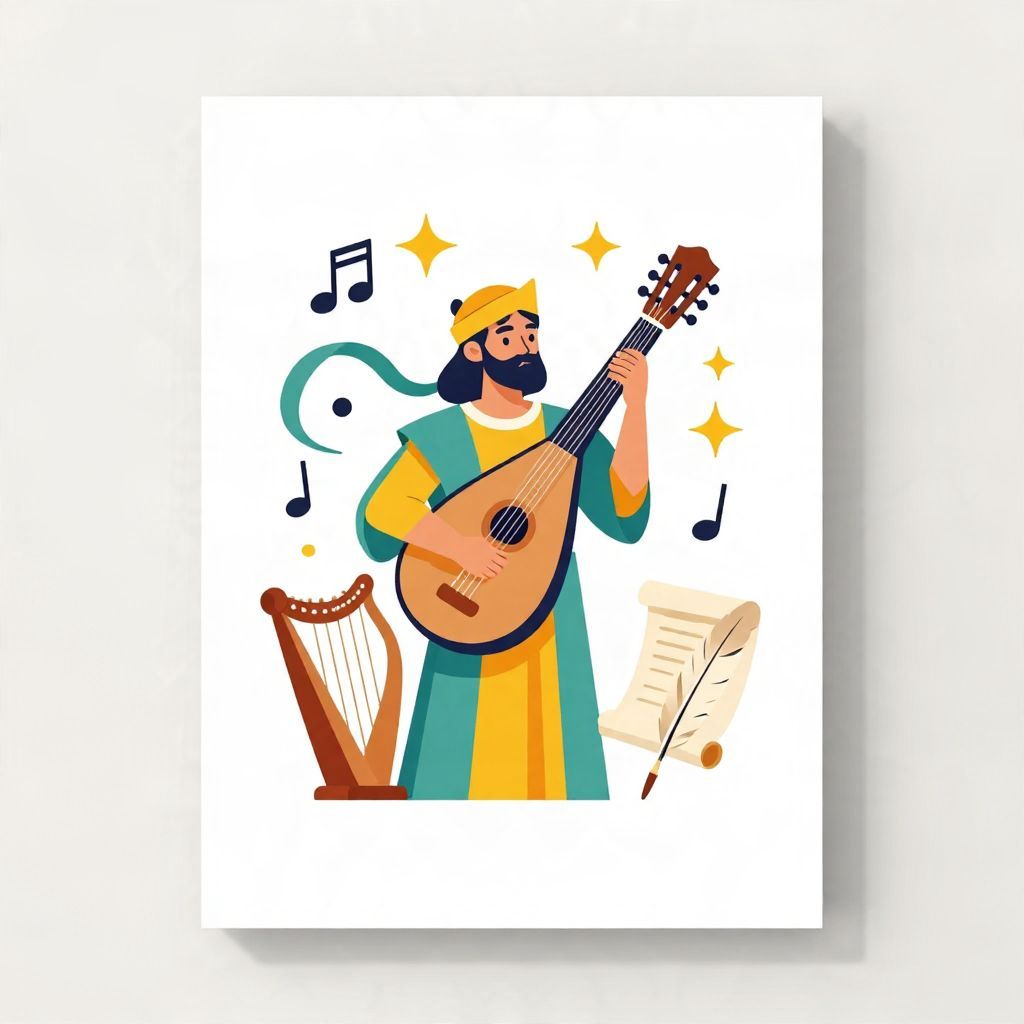
If you’ve ever come across the word troubadour in a poem, song, or history lesson and wondered what it really means, you’re not alone. The term carries both a specific medieval meaning and a broader literary one, and it has shaped how writers think about love, performance, and poetic voice.
In literature, a troubadour is usually a poet-musician from medieval southern France who composed lyric verse, often about courtly love. The word can also describe, more loosely, any wandering singer or poet whose work blends music, storytelling, and public performance.
What is a troubadour in literature?
A troubadour is a medieval lyric poet and composer, especially from the Occitan-speaking regions of southern France, active from roughly the 11th to 13th centuries. Troubadours wrote and performed songs about love, honor, politics, and social ideals, and their work helped shape later European lyric poetry.
Where did troubadours come from?
Troubadours emerged in the courts of medieval southern France, particularly in areas where Occitan was spoken. They were not simply entertainers; many were educated members of the nobility or attached to aristocratic courts, and their poems circulated through performance as well as manuscript culture.
Historical background
The troubadour tradition developed in a courtly environment that valued wit, refinement, and artistic skill. Their songs were often accompanied by music, though many survive today only as texts, which means modern readers encounter them as poetry even when they were originally meant to be heard.
Troubadour vs. trouvère
The troubadours were associated with southern France and the Occitan language. Their northern French counterparts were called trouvères, who wrote in Old French and adapted many of the same lyric forms and themes.
What themes do troubadour poems explore?
Troubadour poetry is best known for its treatment of courtly love, a stylized literary ideal in which the lover often serves, admires, or longs for a beloved from a distance. But the tradition is broader than romance alone and includes satire, political commentary, moral reflection, and personal devotion.
Courtly love
Many troubadour lyrics present love as intense, disciplined, and sometimes painful. The beloved is often idealized, while the speaker emphasizes longing, loyalty, secrecy, or emotional restraint rather than fulfillment.
Honor and social status
Some poems explore the relationship between love and rank, asking how desire operates within a hierarchical society. Others praise generosity, courage, and reputation, reflecting the values of aristocratic culture.
Politics and conflict
Not all troubadour poetry is romantic. Some works comment on war, feudal loyalty, or current events, showing that the troubadour could also be a sharp observer of public life.
What literary forms did troubadours use?
Troubadours worked in highly structured lyric forms, often designed for singing. Their poems rely on pattern, repetition, and musical phrasing, which helped make them memorable in performance.
Common forms
- Canso — a love song, usually the most famous troubadour form.
- Sirventes — a poem often used for satire, politics, or moral criticism.
- Alba — a dawn song, typically involving lovers parting at daybreak.
- Pastorela — a poem that stages an encounter between a knight and a shepherdess or rural woman.
- Tenso — a debate poem, often between two voices.
Sound and structure
Troubadour poetry often depends on rhyme, meter, and repeated stanza patterns. Because these poems were meant to be performed, sound mattered as much as meaning, and the musical quality of the language was part of the art.
Why are troubadours important in literary history?
Troubadours are important because they helped establish the lyric poem as a major literary form in Europe. Their influence can be traced in later medieval poetry, Renaissance love lyrics, and even modern ideas about the poet as a sensitive, wandering, or emotionally expressive figure.
Influence on later writers
The troubadour tradition shaped poetic conventions across Europe, especially in how writers represented desire, devotion, and the speaking self. It also helped define the relationship between poetry and music, a connection that remains central in song lyrics and performance poetry.
The poet as performer
One reason troubadours remain fascinating is that they blur the line between author and performer. In their work, poetry is not silent page text alone; it is something voiced, heard, and shared in a social setting.
What does “troubadour” mean in modern usage?
Today, people often use troubadour more loosely to mean a wandering singer, traveling poet, or romantic performer. This broader sense draws on the medieval image of the artist who moves from place to place carrying songs, stories, and emotional expression.
Common modern associations
- A singer-songwriter with a strong storytelling style
- A poet or musician associated with romance or nostalgia
- A symbolic figure for artistic freedom and travel
That modern usage is not always historically precise, but it reflects the cultural afterlife of the medieval troubadour as a figure of art, movement, and longing.
What are some literary examples of troubadour writing?
Because troubadour poetry survives in many manuscript traditions, it is best understood as a body of work rather than a single book. Still, several poets are especially important for readers who want to understand the tradition.
Notable troubadour poets
- William IX of Aquitaine — often cited among the earliest troubadours.
- Bernart de Ventadorn — known for influential love lyrics.
- Jaufre Rudel — associated with the idea of distant or idealized love.
- Arnaut Daniel — admired for technical complexity and later literary influence.
- Beatriz de Dia — one of the best-known female troubadour voices, often called a trobairitz.
What makes these examples literary?
These poets matter not only for historical reasons but also because their work shows how medieval lyric can be emotionally direct and formally intricate at the same time. They use voice, repetition, and symbolic language to turn personal feeling into crafted art.
How should readers interpret troubadour poetry?
Reading troubadour poetry means paying attention to both convention and feeling. The speaker’s emotions may seem personal, but they are often shaped by literary rules, social expectations, and performance traditions.
Key interpretive ideas
- Persona: the speaking voice may not be identical with the historical poet.
- Convention: love themes often follow established patterns.
- Performance: many poems were meant to be sung or heard aloud.
- Social context: courtly society shaped the values expressed in the poems.
This means a troubadour lyric can be both deeply emotional and highly stylized. Its power often comes from that tension.
How is a troubadour different from a bard or minstrel?
These terms are sometimes used interchangeably, but they are not identical. A troubadour is specifically tied to medieval Occitan lyric poetry, while “bard” is a broader term for a poet-singer, often associated with Celtic traditions, and “minstrel” usually refers to a traveling entertainer or musician.
Simple comparison
- Troubadour: medieval lyric poet-composer, especially in southern France.
- Bard: a general or traditional poet-singer, often linked to oral tradition.
- Minstrel: performer or entertainer, sometimes with music and storytelling.
Why do troubadours still matter to readers today?
Troubadours still matter because they show how literature can be musical, social, and emotionally nuanced all at once. They are a reminder that poetry was not always a silent, private art; it was once a public act shaped by voice, memory, and audience.
For modern readers, the troubadour offers a useful lens for understanding lyric poetry, love conventions, and the history of performance-based literature. If you’re interested in related poetic forms, you may also enjoy reading about what an ode poem is or exploring “We Are the Music Makers” and its literary meaning.
In short: a troubadour is a medieval poet-musician whose lyrics, especially on courtly love, helped shape the history of European poetry. The term also survives today as a symbol of the traveling artist, blending song, storytelling, and emotional expression.