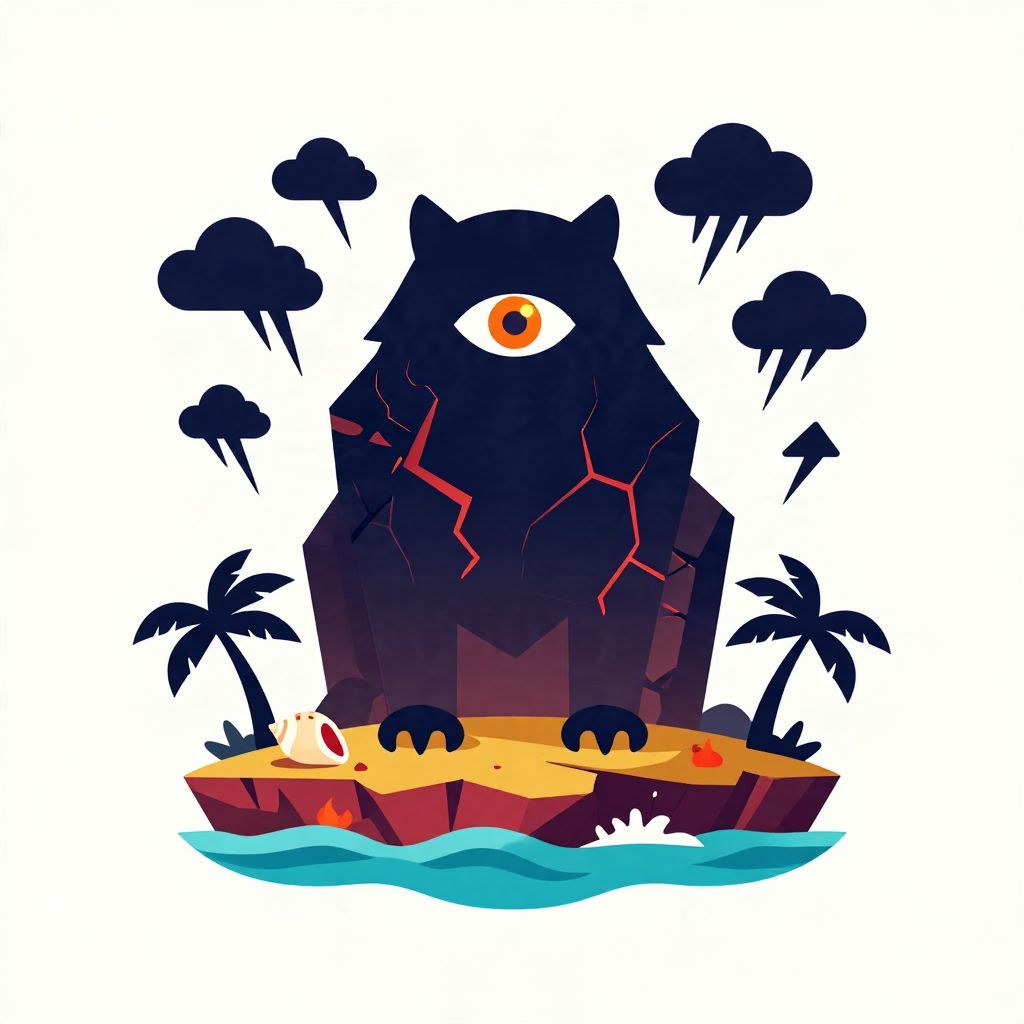
If you’ve wondered what the beast in Lord of the Flies really is, you’re asking one of the novel’s central literary questions. The answer is both simple and unsettling: the beast is first a fear, then a symbol, and finally a way of understanding the darkness the boys carry within themselves.
William Golding uses the beast to show how quickly civilization can weaken when fear, power, and imagination take over. It is not just a monster on the island; it is a test of what human beings become when rules disappear.
What is the beast in Lord of the Flies?
The beast in Lord of the Flies is a symbol of the boys’ fear, especially the fear of the unknown and of their own violent impulses. At first they imagine it as an external creature, but Golding gradually reveals that the real beast is internal: the capacity for cruelty, panic, and savagery that exists in human nature.
How the beast develops in the novel
The first rumors of a monster
The idea of the beast begins as a childish fear. The younger boys, especially the littluns, sense that the island is strange and threatening, and their anxiety gives the fear shape. In a novel about isolation, that fear spreads easily because there are no adults, no reliable structure, and no clear explanation for what is happening around them.
The parachutist and the “beast from air”
Midway through the novel, the boys mistake the dead parachutist for a monster. This is an important turning point because it shows how fear can distort perception. The “beast” seems real to them, but the actual object is a human corpse, which makes the novel’s point even sharper: the true horror comes not from a mythical creature, but from human violence and war.
The Lord of the Flies and the inner beast
The clearest symbolic meaning comes through the pig’s head, the “Lord of the Flies,” which represents corruption and the evil the boys cannot escape. In this scene, Golding suggests that the beast is not outside them at all. It is part of their own minds, growing stronger as order breaks down and fear becomes a form of control.
What the beast symbolizes
Fear itself
On one level, the beast symbolizes fear in its purest form. The boys cannot see it clearly, so they imagine it differently each time. That uncertainty matters, because fear often becomes more powerful when it is vague and unnamed.
The loss of civilization
The beast also stands for the collapse of social order. As the boys stop following rules, their shared life becomes more unstable. The beast becomes a convenient explanation for chaos, but it is really a sign that their community is unraveling.
The darkness in human nature
Golding’s deepest idea is that the beast is a symbol of human savagery. The novel suggests that evil is not merely caused by bad circumstances; it can emerge from within ordinary people when restraint, responsibility, and empathy weaken.
Why the beast matters to the novel’s themes
Civilization versus savagery
The beast is central to the novel’s conflict between civilization and savagery. Ralph tries to preserve order through rules and rescue, while Jack increasingly embraces hunting, intimidation, and violence. The more the boys believe in the beast, the more they act like it.
Innocence and corruption
The boys begin as schoolchildren, but the beast exposes how fragile innocence can be. Their fear and aggression do not come from nowhere; they are awakened and amplified by the island’s isolation. Golding uses the beast to show how innocence can be corrupted when moral guidance disappears.
Power and manipulation
Jack uses the fear of the beast to gain authority. By promising protection, he turns anxiety into loyalty. This is one of the novel’s most important political ideas: fear can be used to control a group, especially when people want simple answers to frightening problems.
Literary techniques Golding uses to build the beast
Symbolism
The beast is a major symbol, but Golding keeps it flexible. It can mean a monster, a rumor, a psychological fear, or a moral truth. That ambiguity is part of what makes the novel powerful.
Foreshadowing
Early references to “something” in the forest create suspense and prepare the reader for later revelations. Golding uses these hints to make the boys’ fear feel believable before it becomes destructive.
Allegory
Lord of the Flies often works as an allegory, meaning its characters and events stand for larger ideas. The beast fits this pattern because it represents more than a plot element; it becomes a way of thinking about society, morality, and human nature.
Imagery and atmosphere
Golding repeatedly uses dark, shadowy, and dreamlike imagery to make the island feel threatening. This atmosphere helps the beast feel omnipresent, even when nothing visible is there. The setting itself seems to encourage fear.
Is the beast real in Lord of the Flies?
Literally, no single supernatural beast appears in the novel. The boys do encounter frightening things, but the beast is not a traditional monster. Golding’s point is that the most dangerous force on the island is not an animal or spirit, but the boys’ own fear and violence.
That said, the novel does not treat the boys’ fear as meaningless. The beast is “real” as an emotional and social force because it changes how they behave. In that sense, the beast has real consequences even if it is not a real creature.
Key scenes connected to the beast
- The littluns’ fears establish the beast as a shared anxiety.
- Simon’s discovery of the pig’s head reveals the beast as an inner truth rather than an external enemy.
- The dead parachutist shows how fear can turn an ordinary object into a monster.
- Jack’s leadership demonstrates how the beast can be used to manipulate others.
- The final descent into violence suggests that the real beast has been unleashed within the boys themselves.
Common interpretations of the beast
The beast as childhood fear
Some readers focus on the beast as a realistic expression of children’s imagination under stress. This interpretation emphasizes psychology and development: the boys are frightened, confused, and separated from adults, so they create a monster to explain their unease.
The beast as social collapse
Another reading sees the beast as a sign that society itself is failing. Without laws, institutions, or accountability, the boys’ community becomes vulnerable to superstition and violence. The beast then represents what happens when social order no longer holds.
The beast as moral evil
A more philosophical interpretation treats the beast as Golding’s statement about evil in human beings. This is the reading most closely tied to the novel’s famous bleakness: the danger is not that people are innocent victims of a monster, but that they can become monstrous themselves.
Why readers still ask what the beast is
The question remains compelling because Golding never reduces the beast to one simple answer. He lets it move between literal fear and symbolic meaning, which makes it feel both dramatic and unsettling. Readers keep returning to it because the beast is not just a creature in a story; it is a mirror for human behavior.
So, if you are asking what is the beast in Lord of the Flies, the most accurate answer is this: it is the boys’ fear made visible, a symbol of corruption, and a warning about the violence that can emerge when civilization fails. For more literary analysis and related reading, you may also enjoy other classic novel guides and symbolism in literature articles.