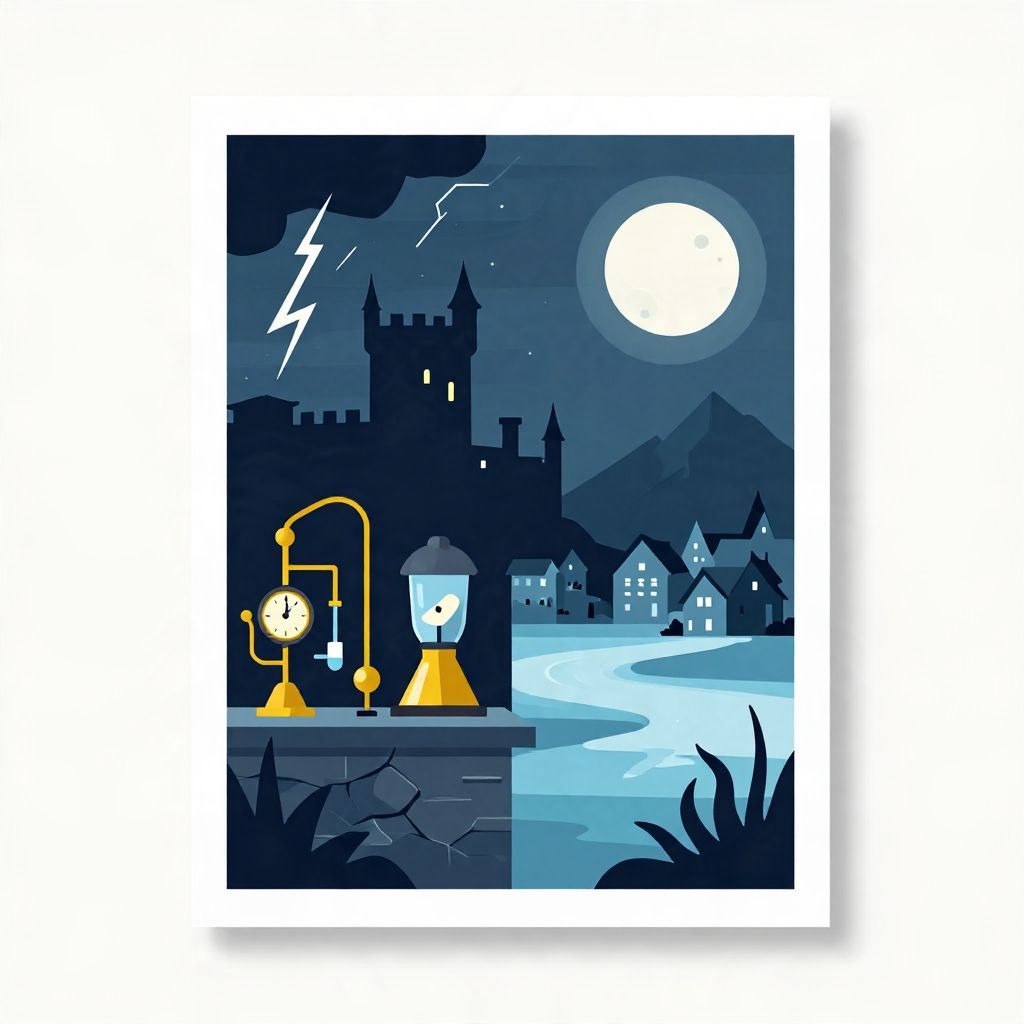
If you’re wondering when Frankenstein takes place, the short answer is that Mary Shelley sets most of the novel in the late 18th century and early 19th century, with the frame narrative beginning in the Arctic. The story moves across several locations and time periods, but its central action unfolds during the years around Victor Frankenstein’s youth, university studies, and the creature’s early life.
Because the novel is told through nested narrators, the timeline can feel slippery at first. A closer look shows that Shelley carefully blends present-tense exploration, retrospective storytelling, and flashbacks to create a Gothic tale rooted in the scientific and cultural world of her own era.
When does Frankenstein take place?
Frankenstein takes place mainly in the late 1700s and early 1800s, though the exact dates are not stated for every event. The frame story begins in the Arctic during Walton’s expedition, and Victor’s account then looks back to his childhood in Geneva, his university years in Ingolstadt, and the later pursuit of the creature across Europe and into the far north.
The novel’s overall timeline
Mary Shelley does not give a precise calendar for every chapter, but the novel’s action is anchored in a recognizable historical period. The setting reflects the age of Enlightenment science, Romantic-era emotion, and early industrial modernity, all of which shape the novel’s concerns about ambition, knowledge, and responsibility.
The Arctic frame narrative
The book opens with Robert Walton’s letters from the Arctic, where he is searching for a route through the polar ice. This opening places the outer frame of the novel in a world of exploration and scientific ambition, matching Victor Frankenstein’s own drive for discovery.
Victor’s earlier life
Victor’s story begins in Geneva, where he describes a privileged childhood, his family, and his early fascination with natural philosophy. From there, the narrative moves to his studies at the University of Ingolstadt, where he becomes obsessed with creating life.
The creature’s early years
After Victor brings the creature to life, the novel follows the being’s first experiences in the world, including his secret observations of the De Lacey family. These events unfold over a period of months and years, though Shelley presents them through retrospective narration rather than a strict dated sequence.
Why the setting matters so much
The time period of Frankenstein is not just background detail. Shelley places the novel in a moment when science, philosophy, and industry were changing how people understood the natural world, and that historical pressure is central to the story’s meaning.
Science and experimentation
Victor’s work reflects the era’s fascination with electricity, anatomy, chemistry, and the boundaries of scientific inquiry. The novel asks what happens when intellectual ambition outruns moral judgment, a question that feels especially tied to the early modern scientific imagination.
Romantic and Gothic atmosphere
The novel also belongs to the Gothic and Romantic traditions, which often use remote landscapes, emotional intensity, and the sublime power of nature. The Arctic, the Alps, and stormy weather all reinforce the sense that human beings are small before forces they cannot fully control.
Social and historical anxieties
Although Frankenstein is not a historical novel in the strict sense, it reflects anxieties about creation, parenthood, isolation, and the consequences of unchecked progress. Its setting in the late 18th and early 19th centuries helps make those concerns feel immediate rather than abstract.
How the novel’s structure affects the timeline
One reason readers ask when Frankenstein takes place is that the narrative is layered. Shelley uses a story within a story within a story, and each narrator looks back on earlier events, which makes the chronology feel indirect even when the sequence is clear.
Walton’s letters
The outermost narrative is Walton’s correspondence with his sister. These letters create the present tense of the novel and establish the Arctic expedition as the book’s immediate setting.
Victor’s retrospective account
Victor then tells Walton about events that happened earlier in his life. This backward-looking narration means the main plot is already in the past by the time it is being told, which is why the novel feels both immediate and historical.
The creature’s embedded narrative
The creature’s own story adds another layer of time. He recounts his experiences after Victor has already abandoned him, so readers are constantly moving between present action and remembered experience.
Where Frankenstein takes place
The novel moves through several important locations, and each one contributes to its meaning. Shelley uses geography to mirror emotional and moral states, so the settings are never just scenery.
- Geneva, Switzerland — Victor’s family home and the site of his early life.
- Ingolstadt, Germany — the university city where Victor pursues his experiments.
- Various Alpine regions — landscapes of reflection, confrontation, and sublimity.
- England and Scotland — places tied to travel, observation, and further moral unraveling.
- The Arctic — the novel’s opening and closing setting, emphasizing isolation and extremity.
These locations help show that the novel is not confined to one country or one moment. Instead, it travels across Europe and into the polar north, giving the story a wide, restless scale.
What historical period is Frankenstein associated with?
Frankenstein is usually associated with the early 19th century, when Shelley wrote and published it, but its fictional events are set slightly earlier. That combination gives the novel a distinctive double perspective: it looks back at the scientific and social world of the late 18th century from the viewpoint of a writer living in the Romantic period.
Publication context
The novel was first published in 1818, with a revised edition appearing later. That publication date matters because it places Shelley at a moment when debates about science, education, gender, and authorship were especially active.
Why readers sometimes feel it is “timeless”
Even though the novel has a historical setting, its questions remain modern: What are the limits of invention? What responsibilities come with creation? What happens when a maker rejects what has been made? Those concerns help the book feel contemporary across centuries.
Common misconceptions about the timeline
Readers sometimes assume that Frankenstein is set in the exact year it was published, but that is not quite right. The novel belongs to the early 1800s in terms of authorship, while its fictional events are placed earlier and spread across a broad, partly unspecified span of time.
It is not a single-year story
The novel does not unfold over one neatly dated year. Instead, it stretches from Victor’s childhood to his adulthood, then extends through the creature’s development and the final Arctic chase.
It is not set in the modern age
Despite its scientific themes, the novel is not a contemporary techno-thriller. Its world is shaped by pre-modern travel, early scientific inquiry, and the slower pace of communication that comes with letters, journeys, and long absences.
Why the time setting helps explain the novel’s themes
Knowing when Frankenstein takes place makes the novel easier to interpret. Shelley’s historical moment helps explain why the story is so concerned with education, social isolation, scientific overreach, and the tension between human aspiration and human limitation.
- Ambition — Victor’s era rewards discovery, but the novel questions the cost.
- Isolation — travel, secrecy, and emotional distance shape nearly every major character.
- Responsibility — the story repeatedly asks who must answer for suffering.
- Nature — mountains, ice, and storms reflect emotional and moral extremes.
In that sense, the setting is inseparable from the novel’s argument. The time period is not merely decorative; it is part of how the book thinks.
Quick answer for readers
If you need the simplest version: Frankenstein takes place mostly in the late 18th and early 19th centuries, beginning with Walton’s Arctic expedition and then moving back through Victor Frankenstein’s life in Geneva, Ingolstadt, and across Europe. Shelley’s layered narration makes the timeline feel complex, but the historical setting is firmly rooted in the Romantic era.
If you want to compare Shelley’s novel with other foundational works of literary history, you may also enjoy when Dracula was written and when the Epic of Gilgamesh was written.