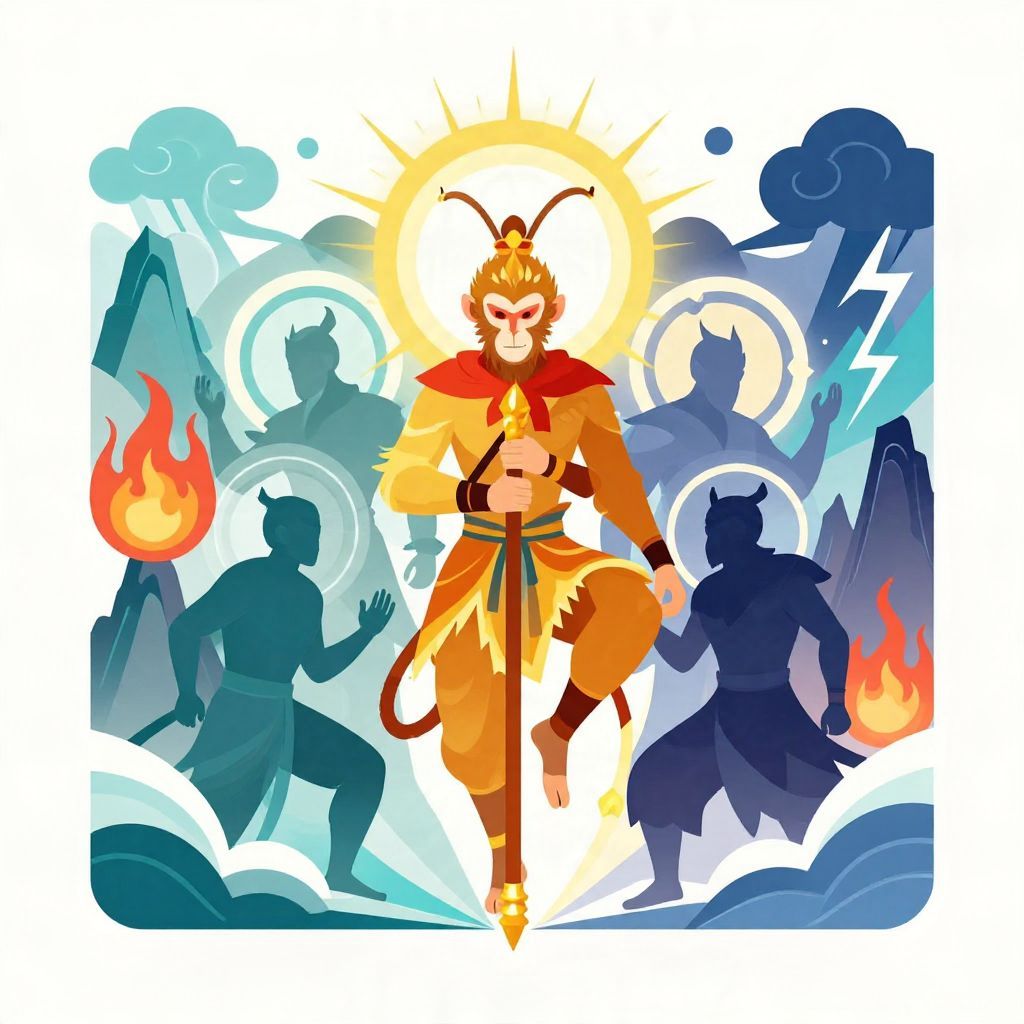
If you’ve ever wondered who can beat Sun Wukong, the answer depends on which version of the Monkey King you mean and what kind of “beat” you have in mind. In Chinese literary tradition, Sun Wukong is not just strong; he is cunning, immortal in several layered ways, and notoriously difficult to contain.
That makes him one of the most fascinating figures in world literature. A serious answer has to look at Journey to the West, the novel’s mythic hierarchy, and the rare beings who can outmatch him through power, authority, or spiritual supremacy.
Who can beat Sun Wukong in Journey to the West?
In the novel’s logic, Sun Wukong can be defeated by beings with higher cosmic authority, especially the Buddha, and by some deities or immortals whose power exceeds his own. He is often stronger than most opponents in direct combat, but he is not the highest force in the story’s spiritual hierarchy.
Why Sun Wukong is so hard to defeat
Sun Wukong is built as an overpowered trickster hero. He is fast, clever, magical, and protected by multiple forms of immortality, which means a normal fight usually does not solve the problem.
His strengths in the novel
- Extreme physical power and combat skill.
- Shape-shifting and magical transformation.
- Cloud travel and supernatural speed.
- Multiple layers of immortality, gained through different mythic events.
- Intelligence and improvisation, which often matter as much as force.
Because of these traits, Sun Wukong can overwhelm many gods, demons, and soldiers. The novel repeatedly shows that brute strength alone is not enough to hold him back for long.
His main weakness
His greatest weakness is not physical vulnerability but limits imposed by higher powers. He can be trapped, disciplined, or transformed by beings who operate above his level in the cosmic order. In other words, he is formidable, but not sovereign.
Who actually beats Sun Wukong?
The clearest answer is the Buddha, who defeats Sun Wukong not through a conventional duel but through overwhelming spiritual authority. In the famous episode, Wukong cannot escape the Buddha’s palm, a scene that emphasizes scale, transcendence, and the limits of rebellious power.
The Buddha
This is the most famous and definitive defeat. Sun Wukong believes he can outrun and outwit any opponent, but the Buddha proves otherwise. The episode is less about martial victory than about cosmic containment: Wukong’s ambition meets a force that is beyond physical struggle.
Guanyin and other divine figures
Guanyin does not “beat” him in the same dramatic way, but she is one of the figures who can control, guide, and restrain him. She plays a crucial role in redirecting his energy toward the pilgrimage and in placing conditions on his behavior.
Other high-ranking celestial beings may not always defeat him outright in single combat, but they can often summon authority, resources, or judgment that he cannot simply overpower.
The restrictive headband
One of the most practical ways Sun Wukong is controlled is through the tightening headband used by Tripitaka. This is not a sign that Tripitaka is physically stronger; instead, it shows that discipline, vows, and spiritual order can restrain raw power more effectively than force can.
Can any demon or warrior beat him one-on-one?
Sometimes Sun Wukong is matched, delayed, or temporarily bested by demons, but these encounters usually depend on special weapons, illusions, traps, or hidden identities rather than simple superiority. The novel delights in making him struggle, yet it rarely lets ordinary enemies permanently defeat him.
When opponents can challenge him
- They possess magical artifacts with unusual properties.
- They use deception, illusion, or terrain instead of direct combat.
- They have divine backing or a status higher than a typical monster.
- They exploit his impulsiveness or pride.
These battles are important because they reveal a central pattern in the novel: Sun Wukong is not defeated by ordinary strength, but by a combination of hierarchy, strategy, and spiritual law.
What does “beat” mean in Sun Wukong’s story?
The phrase “who can beat Sun Wukong” can mean several different things. In a literal sense, it asks who can win in combat. In a literary sense, it asks who can master, discipline, or transcend him.
Physical defeat
Very few characters can defeat him physically in a straightforward fight. Most of the novel’s tension comes from the fact that he is already so powerful that normal combat is not enough.
Spiritual defeat
The more meaningful defeats are spiritual. The Buddha’s victory matters because it shows that Sun Wukong’s rebellion has limits. He may be unstoppable by ordinary means, but he is still subject to a larger moral and cosmic structure.
Psychological defeat
At times, Sun Wukong is also “beaten” by his own flaws: pride, impatience, and overconfidence. These traits create openings for enemies and make him vulnerable to correction.
Sun Wukong as a literary character
Sun Wukong is one of the great trickster figures in world literature. He combines comic energy, anarchic rebellion, and genuine heroism, which makes him far more complex than a simple superhero or villain.
Why readers remember him
He is memorable because he refuses to fit neatly into one role. He is mischievous and loyal, selfish and protective, rebellious and eventually disciplined. That contradiction gives Journey to the West much of its energy.
His symbolic meaning
Many readers see Sun Wukong as a symbol of untamed desire, youthful rebellion, or the unruly mind. His journey suggests that power alone is not enough; it must be shaped by discipline, humility, and purpose.
How the novel uses his defeats
Sun Wukong’s defeats are not just action scenes. They are structural moments that help the novel explore order versus chaos, enlightenment versus ego, and authority versus rebellion.
Defeat as correction
When he is beaten or restrained, the story is often showing that strength without self-mastery is incomplete. His losses become part of his growth, even when he resists that growth at first.
Defeat as comedy and spectacle
The novel also uses his setbacks for humor. Watching such an arrogant and capable figure get outmaneuvered is part of the book’s playful tone, and it helps balance the epic scale of the adventures.
Reading Journey to the West with this question in mind
If you are reading the novel specifically to understand who can beat Sun Wukong, pay attention to how power is defined in each episode. The book does not treat strength as one simple measurement; it distinguishes between martial skill, magical ability, moral authority, and spiritual realization.
What to watch for
- Who has the highest authority, not just the strongest weapon.
- When Sun Wukong is defeated by rules rather than force.
- How often his enemies rely on traps, spells, or deception.
- How the novel contrasts rebellion with discipline.
This perspective turns the question into a richer literary one: not merely “who is stronger?” but “what kind of power does the novel respect most?”
So, who can beat Sun Wukong?
The short answer is that only beings with superior cosmic or spiritual authority can truly beat Sun Wukong, and the Buddha is the clearest example. Most other opponents can delay him, trick him, or temporarily restrain him, but they rarely surpass him in a direct contest of power.
That is why Sun Wukong remains such a lasting literary icon: he is almost unbeatable, yet the story still finds ways to challenge him. If you want more book and character guides, you may also enjoy how many books are in the Throne of Glass series and how old Percy Jackson is in the series.