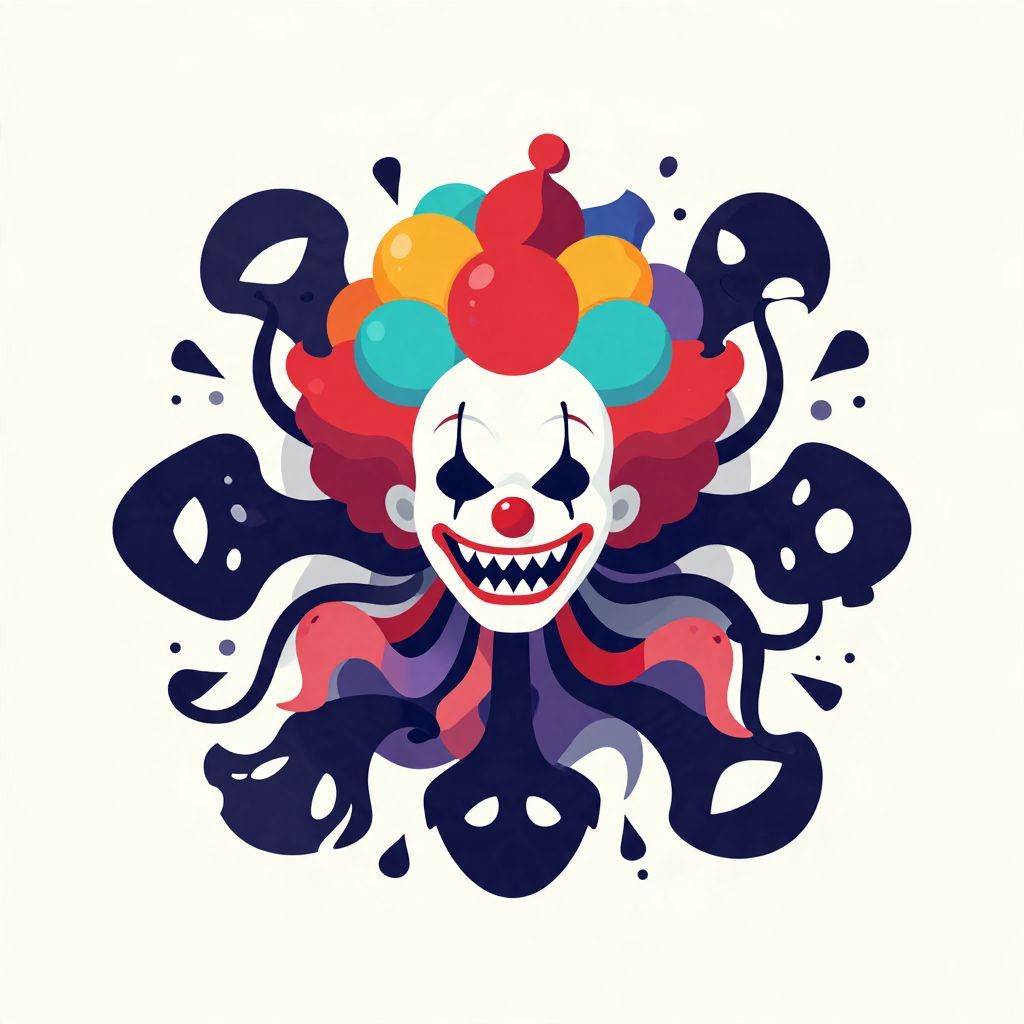
Readers often ask what Pennywise really is because the clown is only the most visible shape of something far stranger. In Stephen King’s It, Pennywise is a mask worn by an ancient, predatory entity that feeds on fear, and the novel leaves room for both literal and symbolic readings of that terror.
Understanding Pennywise’s true form means looking at the creature’s shifting appearances, the mythology around It, and the way King uses uncertainty to make fear feel larger than any single image.
What is Pennywise’s true form?
Pennywise’s true form is not a permanent clown body but the alien, interdimensional being known as It. In the novel, the clown is a chosen appearance designed to attract children, while the creature itself is beyond ordinary human perception and can take many shapes, often reflecting whatever its victims fear most.
Pennywise in It: the clown as a disguise
Pennywise the Dancing Clown is the form most readers remember because it is the one that appears most often in the story. But the clown is only one costume among many, and it functions as a lure: friendly enough to lower defenses, uncanny enough to unsettle.
This contrast is central to King’s horror technique. The more ordinary Pennywise seems on the surface, the more disturbing it becomes when the reader realizes that the friendliness is part of the trap.
Why the clown form matters
The clown image works because it twists something that should be playful into something predatory. Clowns already occupy an uneasy place in popular culture, and King uses that cultural unease to make Pennywise immediately legible as a threat.
At the same time, the clown is practical within the story. It is a shape that helps the creature approach children in a town where adults often fail to notice what is happening.
What does Pennywise look like in its true form?
King never gives a fully stable, humanly knowable description of Pennywise’s ultimate form. Instead, the novel suggests that the creature’s real nature is difficult for the human mind to hold, and when characters glimpse it, the experience is overwhelming, distorted, or only partially understood.
That uncertainty is deliberate. The book implies that Pennywise’s essence is so far outside human experience that language can only approximate it, which is one reason the horror feels cosmic rather than merely physical.
The “deadlights” and the limits of perception
One of the novel’s most important concepts is the deadlights, a terrifying aspect of the creature’s being that humans cannot safely perceive. The deadlights are less a neat visual description than a sign that Pennywise belongs to a reality beyond ordinary sight.
In literary terms, this is a classic example of the unspeakable monster: the more impossible the thing is to fully describe, the more it can dominate the imagination.
Is Pennywise an alien, demon, or monster?
Pennywise is best understood as an ancient cosmic entity rather than a conventional monster from folklore. The novel presents It as something that came from outside human civilization and has been active for ages, feeding on fear and preying on vulnerable communities.
That said, readers sometimes describe Pennywise as demon-like because the creature behaves like a spiritual predator. The novel itself does not reduce It to a simple category, and that ambiguity is part of its power.
Why the classification stays blurry
King’s horror often resists tidy taxonomy. By making Pennywise difficult to classify, the novel keeps the creature from becoming manageable, and that lack of certainty mirrors the experience of the children in the story, who can sense danger before they can explain it.
In other words, the mystery is not a gap in the writing; it is the horror.
The literary function of Pennywise’s shifting forms
Pennywise does not just change shape for spectacle. The transformations dramatize the novel’s central idea that fear is deeply personal. Each character is threatened by something tailored to their own psychological vulnerability, which makes the monster feel intimate rather than generic.
This is one reason It remains so memorable: the creature is not merely a body to defeat, but a force that turns private dread into visible threat.
Fear as a mirror
By reflecting each victim’s terror back at them, Pennywise becomes a mirror of the mind. The monster’s shape-shifting is therefore both plot device and theme, showing that fear often gains power by taking forms we already half-recognize.
That idea connects Pennywise to a broader literary tradition in which monsters embody social anxieties, childhood fears, or psychological wounds.
What Pennywise symbolizes in Stephen King’s novel
Pennywise can be read as a symbol of many things at once: childhood trauma, buried memory, the persistence of evil, and the way communities ignore suffering until it becomes impossible to deny. Because the creature feeds on fear, it also represents the cycle by which terror sustains itself.
The town of Derry matters here. Its collective forgetfulness and denial help create the conditions Pennywise needs, making the monster both supernatural villain and expression of a damaged social environment.
Common symbolic readings
- Childhood fear — the novel turns ordinary childhood anxieties into literal danger.
- Repressed memory — the adults’ inability to remember or confront the past echoes the creature’s influence.
- Social decay — Derry’s indifference suggests that evil thrives where communities look away.
- Cosmic indifference — Pennywise is not moral in a human sense; it is hungry, ancient, and uncaring.
How King uses ambiguity to make Pennywise scarier
One of King’s most effective techniques is withholding a fixed image of the creature. Instead of giving readers a single definitive monster portrait, he offers fragments, impressions, and shifting manifestations that keep the imagination active.
This strategy is especially effective in horror because the mind often creates something more frightening than any exact description could provide. Pennywise becomes terrifying not only because of what it is, but because it can never be fully pinned down.
Horror through partial revelation
The novel repeatedly lets readers see just enough to feel dread, then pulls back before the creature becomes ordinary. That pattern preserves mystery and prevents the monster from becoming merely decorative.
In literary terms, this is a strong example of suspense built through delayed disclosure.
Pennywise in adaptations versus the novel
Many readers first encounter Pennywise through film or television, where the clown form tends to dominate the visual identity of the character. Adaptations often need a more concrete image than the novel does, so they emphasize the clown because it is memorable, recognizable, and easy to stage.
But the book’s version is broader and stranger. The novel’s Pennywise is not just a clown villain; it is one expression of a larger, more elusive horror that the story deliberately refuses to simplify.
Why the book feels more expansive
On the page, King can move between rumor, memory, hallucination, and myth in ways that cinema usually cannot. That flexibility allows the true form of Pennywise to remain unstable, which is essential to the novel’s atmosphere.
Why readers still ask about Pennywise’s true form
The question persists because Pennywise is one of literature’s most memorable shape-shifters, and because the novel invites interpretation rather than certainty. Readers want a clear answer, but the story’s deeper design depends on the fact that no single answer is fully satisfying.
So the best answer is both simple and unsettling: Pennywise’s true form is It, an ancient, fear-feeding entity whose clown appearance is only one of many masks.
Quick takeaway for readers
If you are asking “What is Pennywise true form?” the most accurate literary answer is that the clown is a disguise, not the creature’s essence. Stephen King uses that hidden identity to explore fear, memory, and the limits of human understanding, making Pennywise frightening precisely because it can never be fully seen.
For more related reading, you may also enjoy Does Pennywise Have a Daughter? and How I Met My Monster.