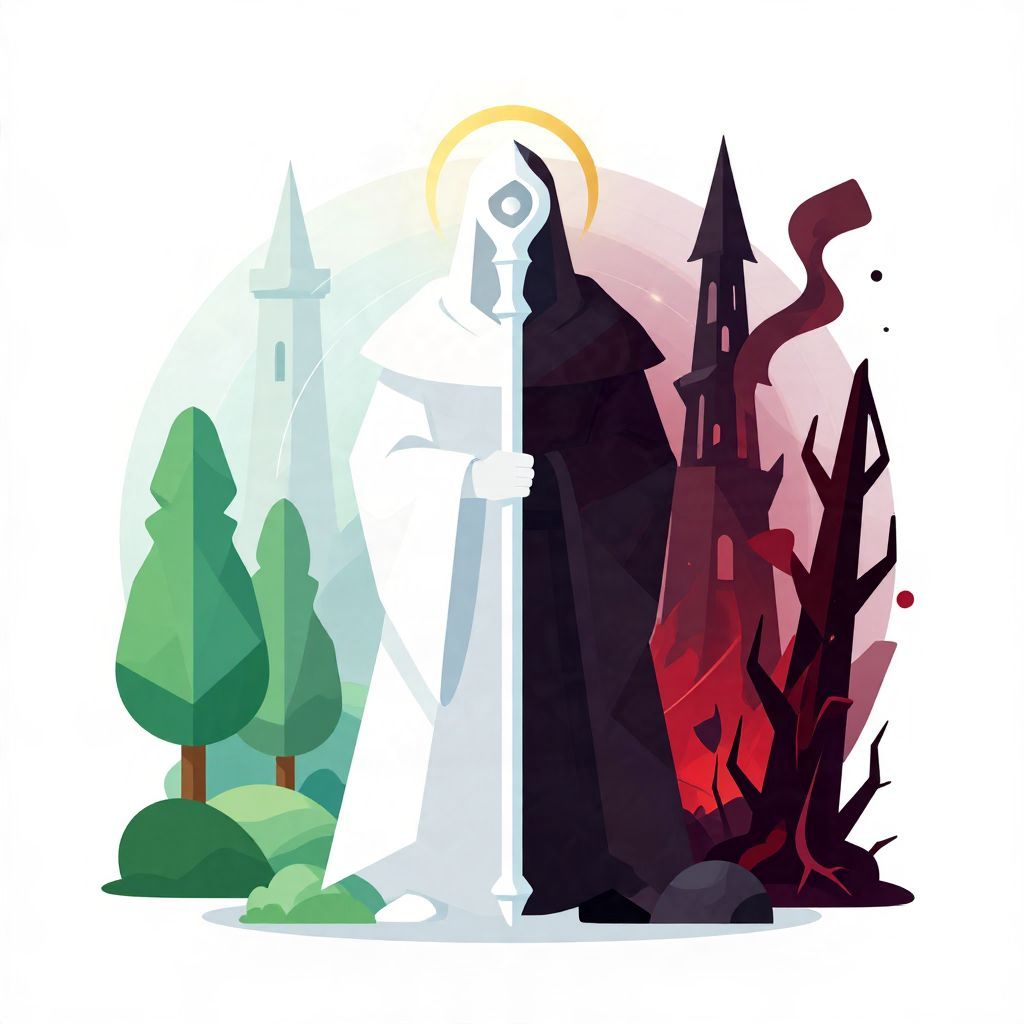
If you’ve ever wondered why Saruman turned evil, the short answer is that Tolkien presents his fall as a mix of pride, desire for power, and a dangerous belief that he could master evil instead of resisting it. In The Lord of the Rings, Saruman’s corruption is not sudden; it grows out of his intellect, ambition, and fascination with domination.
His story matters because it shows one of Tolkien’s clearest warnings: wisdom without humility can become a path to ruin.
Why did Saruman turn evil?
Saruman turns evil because he becomes proud, covets power, and convinces himself that he can use Sauron’s methods for his own ends. Tolkien frames his fall as a moral and spiritual corruption: Saruman begins as a wise leader, but his desire to control others gradually replaces his original duty to oppose evil.
Saruman’s fall in The Lord of the Rings
Saruman is introduced as Saruman the White, the head of the order of the Istari, or wizards. He is meant to guide and advise, not rule. Over time, however, he stops serving that purpose and starts pursuing mastery, first through knowledge and then through force.
This shift is important because Tolkien does not portray Saruman as evil from the start. Instead, he is a tragic figure whose gifts make his downfall more severe.
From wisdom to pride
Saruman’s defining weakness is pride. He comes to believe that his understanding of power makes him superior to others, including the very people he was sent to help. That pride isolates him and makes him vulnerable to self-deception.
In Tolkien’s moral universe, pride is not just arrogance; it is a refusal to accept limits. Saruman cannot tolerate the idea that he should remain a servant rather than become a ruler.
His fascination with power
Saruman is also drawn to the practical advantages of power. He studies the enemy closely, but instead of learning how to resist evil, he becomes fascinated by its efficiency, discipline, and reach. He begins to imitate the logic of domination.
That is one of the most unsettling parts of his fall: he does not simply oppose Sauron, he starts to resemble him.
The temptation to imitate evil
One of Tolkien’s key ideas is that evil often corrupts by imitation. Saruman thinks he can fight fire with fire, but in doing so he adopts the same methods he claims to reject. He turns to surveillance, manipulation, industrial destruction, and coercion.
This makes his corruption especially tragic. He is not seduced by chaos alone; he is seduced by the promise of control.
The palantír and the lure of knowledge
Saruman’s use of the palantír, the seeing-stone, deepens his fall. Through it, he gains access to dangerous knowledge and becomes entangled in Sauron’s influence. The stone is not evil in itself, but Saruman’s overconfidence makes him think he can handle what is beyond him.
The palantír symbolizes a classic Tolkien theme: knowledge without moral discipline can become a trap. Saruman wants understanding, but what he really seeks is leverage.
Why intelligence alone is not enough
Saruman is often described as wise, and he is certainly intelligent. But Tolkien separates intelligence from wisdom. Saruman has the first without the second.
True wisdom in Tolkien includes humility, patience, and loyalty to the good. Saruman loses those qualities, so his brilliance becomes a tool for corruption rather than insight.
What role does jealousy play?
Jealousy also helps explain why Saruman turned evil. He resents Gandalf, who remains more flexible, more compassionate, and ultimately more faithful to the mission. Saruman wants authority, but Gandalf increasingly represents the kind of leadership Saruman cannot control.
That resentment feeds his bitterness. He does not merely want victory; he wants recognition and supremacy.
Resentment of Gandalf
Gandalf’s independence and moral clarity expose Saruman’s weakness. Saruman had expected to lead the resistance, but he cannot accept being outshone by someone he considers less formally powerful.
His anger at Gandalf is therefore not just personal rivalry. It is a sign that his ego has overtaken his duty.
His rejection of limits
Saruman’s fall also reflects a refusal to accept the limits placed on him as one of the Istari. The wizards are sent to guide, not dominate. Saruman rejects that role and tries to become a power in his own right.
In Tolkien’s terms, this is a profound error: the attempt to rule the world rather than serve it.
Industrial imagery and the corruption of nature
Tolkien uses Saruman’s domain at Isengard to show what his evil looks like in practice. The destruction of trees, the machinery of war, and the smoke and noise of industry all reflect his inner decay.
Nature in Tolkien often represents harmony, life, and stewardship. Saruman’s industrial obsession stands in direct opposition to that vision.
Orthanc and Isengard as symbols
Orthanc, Saruman’s tower, and the transformed landscape around it symbolize his moral transformation. What was once a place of strength becomes a place of exploitation. He reshapes the land to serve his ambitions.
This is not just background detail. It is Tolkien’s way of making Saruman’s corruption visible in the physical world.
The Scouring of the Shire as a warning
By the time of the Scouring of the Shire, Saruman’s evil has become petty as well as destructive. He is no longer a grand strategist but a smaller, meaner tyrant. His fall has stripped away grandeur and left only control, resentment, and waste.
That ending reinforces Tolkien’s point: evil diminishes those who serve it.
Is Saruman purely evil?
Saruman is not written as a cartoon villain. Tolkien gives him a tragic arc, which means readers can see how he might have remained good if he had chosen differently. His evil is real, but it grows from recognizable human weaknesses.
That complexity makes him one of the most interesting characters in the legendarium.
A tragic fall, not a simple transformation
Saruman’s corruption is gradual. He does not wake up one day evil; he compromises, rationalizes, and overreaches until his choices define him. This is what makes him tragic rather than merely monstrous.
Tolkien often suggests that evil enters through small acts of self-justification before it becomes openly destructive.
Can Saruman be redeemed?
The question of Saruman’s redemption is complicated. He is given opportunities to turn back, but he repeatedly refuses them. By the end, he has hardened into bitterness and cruelty.
Tolkien leaves little room for easy sympathy, yet he does show that Saruman’s downfall began long before his final defeat. That makes him a cautionary example more than a simple villain.
Key themes in Saruman’s corruption
- Pride — Saruman believes he is above the limits that govern others.
- Power and control — He seeks mastery rather than service.
- Imitation of evil — He adopts the enemy’s methods and mindset.
- Knowledge without humility — Intelligence becomes dangerous when detached from ethics.
- Industrial destruction — His rule damages both people and the natural world.
How Tolkien uses Saruman to deepen the story
Saruman is important because he shows that evil is not always crude or obvious. It can begin in intelligence, ambition, and good intentions twisted by pride. That makes him a powerful contrast to characters who remain faithful despite fear or weakness.
He also broadens the moral landscape of The Lord of the Rings. The story is not only about defeating an external dark lord; it is also about resisting the temptation to become like the enemy.
Why Saruman matters in the larger mythology
Saruman’s fall echoes one of Tolkien’s central concerns: the corruption of good powers through the desire to dominate. This theme appears throughout the legendarium, but Saruman is one of its clearest embodiments in The Lord of the Rings.
He helps Tolkien show that evil can wear the face of wisdom, leadership, and even progress.
Final takeaway
Why did Saruman turn evil? Because his pride, jealousy, and hunger for power led him to abandon humility and imitate the very force he should have opposed. Tolkien uses Saruman to show that corruption often begins when a wise person decides that moral limits no longer apply to them.
If you’re exploring Tolkien’s darker characters and symbols, you may also enjoy reading about what the Beast means in Lord of the Flies and how Voldemort became Voldemort.